


The sales funnel is top, middle, and bottom—everyone has heard this explanation, and that's precisely why it quickly stops being helpful. In B2B sales, with longer decision cycles and multiple decision-makers along the way, the simple linear funnel metaphor hides more than it reveals. This article treats the B2B funnel for what it truly is: a system with specific stages, objective criteria for passing between them, and a breaking point that is rarely where everyone looks.
What is a B2B sales funnel
A B2B sales funnel is the structured representation of the path an opportunity takes from the first contact to closing, and ideally, to expansion after closing. The difference from a B2C funnel isn't just in name. In B2C, the cycle is usually short, and the decision is individual. In B2B, the cycle extends for weeks or months, the ticket size is larger, and the decision is rarely made by just one person: there's a buying committee, with different interests and criteria within the same negotiation.
The biggest problem with the B2B funnel isn't at the top
The most common cause of a "broken" funnel isn't a lack of volume entering the top. It's a misalignment of metrics between departments. Marketing measures MQLs (how many leads they generated). Sales measures closed revenue. Operations measures team productivity. Each department is optimizing its own metric, and none of them are looking at the entire funnel end-to-end.
This misalignment explains a very common pattern: marketing delivers volume and feels successful, sales receives this volume and complains that "the leads are bad," and no one can pinpoint exactly at which stage conversion is leaking, because there isn't a shared definition of what constitutes a "qualified lead" between the two departments.
Signs that the funnel is broken
- Leads stalled in the middle of the funnel, neither advancing nor being disqualified
- Very high loss rate concentrated at a specific stage
- Marketing and sales having different definitions of what a "qualified lead" is
How to structure each stage in practice
Solving this requires objective criteria, not intuition, at each transition point:
- Passage criteria: what needs to be true about an opportunity for it to advance to the next stage, defined beforehand, not decided on a case-by-case basis
- Stage owner: who "owns" each phase (marketing, SDR, or account executive), to prevent an opportunity from lacking a clear owner
- Minimum CRM information: what needs to be filled in at each stage for the next stage to make sense
- Advancement or disqualification triggers: explicit criteria, not "salesperson's hunch," to decide if an opportunity proceeds or exits the funnel
At the top of the funnel, the work involves account mapping and prioritization, a territory already covered in depth in our article on market intelligence-driven outbound prospecting. In the middle of the funnel, qualification and nurturing criteria come into play, and the concept of lead scoring deserves its own article: we cover it in depth in "B2B Lead Generation with AI." At the bottom of the funnel, what changes the closing rate is less about volume and more about timing and proposal relevance.
An illustrative case
A SaaS company generates 600 leads per month through content and paid campaigns. The sales team, however, can only truly work with about 20 of these leads. The rest remain stalled, with no clear criteria for why they were ignored. Marketing blames sales for not leveraging the generated volume; sales blames marketing for the quality of what arrives. Learn more about inbound marketing B2B.
What resolves this dispute is not more volume or more pressure on one department or another. It's data. By analyzing actual conversion history, a pattern of common characteristics emerges among leads that actually became customers in the past. The team redefines the qualification criteria together, with both departments agreeing on the same standard. The result: fewer leads pass to sales, but the SQL rate increases, the sales cycle shortens because those who arrive are already more aligned with the right profile, and the win rate grows.
The Intelligent Sales Funnel
Instead of the cliché top/middle/bottom, we propose a model with its own identity, which describes what actually happens in a well-structured funnel, including the step that the traditional metaphor always forgets: learning from what has already happened.
Get the next articles by email
New content from Draivv, straight to your inbox. No spam.
Diagnose → Prioritize → Engage → Convert → Learn.
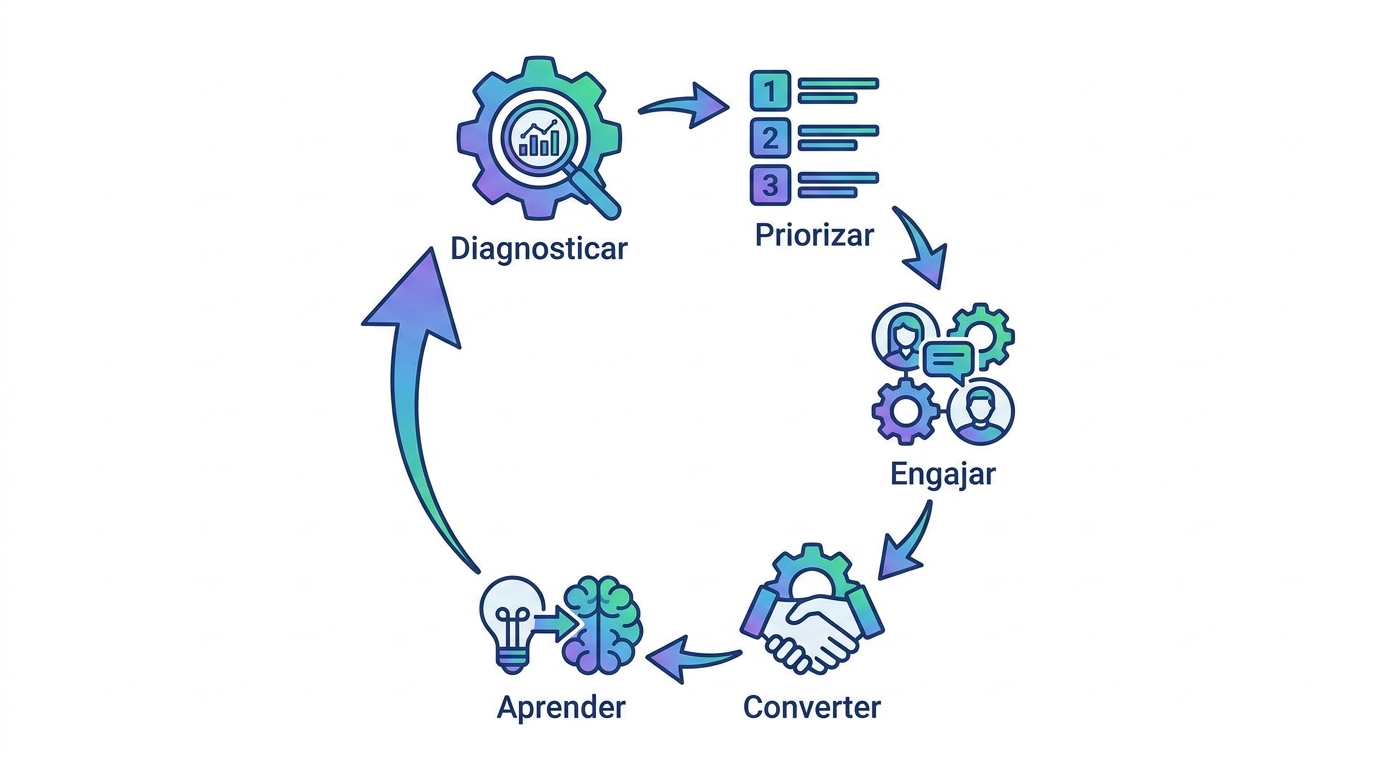 The final stage is not decorative. "Learn" feeds back into "Diagnose." It's a continuous cycle, not a straight line that ends at closing. Every closed or lost deal becomes data for the next diagnostic cycle. It is this cycle, incidentally, that Draivv applies in its B2B lead generation: every reply goes into the CRM with context and shapes the next round of outreach.
Where AI fits into each stage
The correct order is always problem first, tool second, because the problem remains the same even when the specific tool changes its name.
A practical example: the problem "the sales team doesn't know what was said in the previous call with that prospect" has direct application in conversation intelligence. Tools like Gong, Modjo, or Chorus solve precisely this gap, capturing and summarizing conversation history for whoever takes over the negotiation next.
Common errors table
| Error | Consequence |
|---|---|
| Marketing generates volume without a defined ICP | Low-quality leads enter the funnel |
| Lead scoring based only on form completion | Poor prioritization, unrelated to real buying potential |
| Outdated CRM | Any AI model learns from incorrect data |
| Each department uses a different metric to measure success | Funnel remains misaligned, even with good intentions from all |
| Automation applied without underlying strategy | Scales waste, not results |
Metrics per stage
Monitoring a B2B funnel requires specific metrics per stage, not just a general conversion rate: MQL to SQL rate, average time in each stage, and win rate by lead source (to understand which acquisition channels bring opportunities that actually close). And if the funnel you are measuring does not yet start from a solid market mapping, it's worth taking a step back and checking our guide on B2B customer acquisition with AI.
B2B sales funnel with AI in practice
A well-structured funnel is a prerequisite, not a consequence. Artificial intelligence amplifies a funnel that already works; it does not, by itself, fix a funnel that is fundamentally broken due to a lack of criteria and alignment between departments.
The right technology only yields results when applied to a process that already makes sense without it, and it is precisely this prior diagnosis—understanding where the funnel is broken before applying any automation—that Draivv conducts with each client.
Learn more about Draivv on the website!