

In late 2024, Klarna decided to replace Salesforce's flagship CRM with its own AI-powered system. This move gained significant traction as it coincided with the so-called “SaaSpocalypse,” which encapsulated a broader shift: AI began to challenge the per-seat SaaS model, precisely the logic that underpinned much of enterprise software for decades.
This pressure is not marginal. According to coverage compiled by Roberto Dias Duarte, an expert in Accounting AI at RDD10+, a wave of sales in the sector erased approximately US$1 trillion in market value from software and services stocks. The core point isn't that buying software no longer makes sense. It's that the equation between buying and building has changed — and for IT and operations leaders, this places architectural decisions back at the heart of strategy.
“Choose ‘build’ for differentiation, not euphoria: building with AI can be powerful when it becomes a competitive advantage, integrates proprietary data, and improves core processes,” states Roberto Dias Duarte, an expert in Accounting AI at RDD10+.
This is the new context of build vs buy in AI: it's no longer just about comparing CAPEX, timelines, and teams. It's about deciding where the company needs tailored, integrated intelligence — and where an off-the-shelf platform remains the most efficient choice.
AI Has Reshaped the Logic of Buying, Not Eliminated SaaS
For years, the argument for buying was clear: subscribing to SaaS was faster, simpler, and less risky than developing in-house. This rationale remains valid in many cases, especially since SaaS is cloud-based software acquired from providers and consumed as a service, with continuous updates and scalability.
The problem is that AI has precisely altered the economic foundation of this choice. The perspective presented in RDD10+'s coverage is direct: AI agents, including code agents, reduce the cost and time to build software while simultaneously weakening the per-seat billing model.
“AI agents (including code agents) reduce the cost and time to build software and, at the same time, weaken the billing unit that sustained much of SaaS: the seat (‘per seat’),” notes Roberto Dias Duarte, an expert in Accounting AI at RDD10+.
This point helps explain why the market began to question the terminal value of SaaS companies. Historically, the model was seen as one of the most attractive in the sector, with gross margins of 70% to 90%. When AI reduces the reliance on multiple human users to perform tasks, the logic of expansion through licenses begins to lose its strength.
From a market perspective, this doesn't signify the end of SaaS. It means that buying is no longer the automatic answer to every operational problem. In many workflows, the question is now different: does the off-the-shelf software solve the process as it is, or does it force the company to adapt the process to the product?
When Building Makes Sense: Differentiation, Proprietary Data, and Core Processes
The best defense for building isn't in the technology itself. It lies in the degree to which the solution connects to what the company has that is least replicable.
When AI begins to operate on proprietary data and improve core business processes, building in-house can shift from being an IT project to a strategic asset. This is the point emphasized by Roberto Dias Duarte when arguing that building only makes sense when it generates real differentiation.
This advantage appears on three fronts already consolidated in the build vs buy literature in IT:
- Total customization of the solution
- Absolute control over roadmap, updates, and integrations
- Intellectual property of the developed product
Rocketseat objectively summarizes this reasoning by pointing out that an exclusive solution can function as a “secret recipe” that is difficult to copy, precisely aligned with the company's strategy.
This framework is especially relevant in AI applied to operations. In processes with unique rules, frequent exceptions, multiple data sources, and a need for fine integration, custom software with artificial intelligence tends to capture the real business context better than a generic tool.
In practice, building gains strength when the question is:
- Is the process central to revenue, margin, or customer experience?
- Does the operation depend on data that only the company possesses?
- Does differentiation come from the workflow, not just the interface?
- Would adapting to SaaS create bottlenecks or a loss of quality?
If the answer to this set of questions is yes, building becomes sensible not due to technical preference, but due to strategic alignment.
When Buying Remains the Best Decision
Not every demand warrants custom software. In many cases, buying remains the most rational way to achieve productivity without increasing complexity.
This is especially true for more utilitarian needs, where the primary gain is in getting a capability up and running quickly. As the SaaS model delivers cloud software with continuous updates and scalability, it remains competitive when a company needs to solve a common problem without turning it into a proprietary asset.
The point here is to avoid a mistake that the current AI wave might encourage: confusing the drop in development cost with automatic build viability.
The factual basis of the brief itself is clear about the costs of in-house development. Building from scratch requires heavy investment in team, infrastructure, and time. It also carries the risk of delays, execution failures, and continuous maintenance after delivery.
Rocketseat objectively lists these disadvantages:
- Higher initial cost
- Longer development time
- Risk of delays or failures
- Continuous maintenance
- Diversion of focus from the core business
Digitaliza Pro reinforces the same point by highlighting that in-house development can be time-consuming and costly, requiring significant investments in time and human resources.
This matters because AI has lowered barriers, but it hasn't eliminated the need for architecture, integration, technical governance, and support. In other words: it's become easier to build, but it hasn't become free to maintain.
From a market perspective, buying remains superior when the company seeks:
- Speed of implementation
- Operational predictability
- Lower exposure to execution risk
- Coverage of standardized processes
- Internal team focus on more strategic priorities
In these scenarios, purchasing AI tools for automation or SaaS platforms with AI features can generate productivity without creating a new permanent development front.
The New Decision Criterion: Standardized Utility or Tailored Intelligence
The most significant change brought by AI is perhaps this: the discussion has shifted from “building is expensive, buying is fast” to “where standardization suffices and where it destroys value.”
The era of BYOS — Build Your Own Software — emerges precisely as a response to this new ease of building software that better adheres to the company's real processes. The market signal is clear enough to warrant attention: the idea that companies will once again build significant parts of their stack no longer seems an exception.
This shift doesn't invalidate buying. It makes the decision more selective.
A practical way to organize this choice is to separate two blocks.
Scenarios Where Buying Tends to Win
Here, off-the-shelf software is usually more efficient:
Get the next articles by email
New content from Draivv, straight to your inbox. No spam.
- Widely standardized processes
- Need for rapid production deployment
- Low dependence on proprietary data
- Little need for operational differentiation
- Internal team without available capacity to support the product
Scenarios Where Building Tends to Gain Strength
Here, custom software with artificial intelligence begins to make economic and strategic sense:
- Core business processes
- Intensive use of proprietary data
- High need for customization
- Specific integrations with internal systems
- Pursuit of a hard-to-copy competitive advantage
Roberto Dias Duarte's synthesis helps avoid exaggerations on both sides. Building can be powerful, but only when it improves core processes and transforms proprietary data into an advantage. Otherwise, the company risks trading an operational bottleneck for an engineering bottleneck.
The Market Is Already Testing New Software Models
The discussion about build vs buy in AI doesn't happen in a vacuum. It's being pressured by concrete signals from the software market.
The first is the Klarna case, which became symbolic for showing a large company replacing a consolidated SaaS system with its own AI-based alternative.
The second is the financial pressure on the sector. RDD10+'s coverage reports that the wave of sales erased approximately US$1 trillion in market value from software and services stocks. When this happens in a sector historically rewarded for margins of 70% to 90%, the market is pricing in a structural change, not just a short-term fluctuation.
The third signal comes from AI-native companies, which are already testing alternative business and pricing models. The example cited is Sierra, which achieved US$100 million in ARR in less than 2 years.
These three movements point in the same direction:
- Enterprise software remains relevant
- The way this software is packaged, billed, and delivered is under review
- AI expands the scope for tailored solutions in critical workflows
From a market perspective, this suggests a more hybrid coexistence between off-the-shelf platforms and proprietary layers. Instead of choosing between 100% build or 100% buy, many companies tend to purchase the foundation and build the integrated intelligence that truly differentiates their operation.
What Is Current, What Is a Market Signal, and What to Monitor
As there is no official legal or regulatory reference in the source material for this topic, the framing here must be strictly market-based.
What Is Current
The facts supported by the sources are these:
- Companies can still choose between developing in-house or buying off-the-shelf software
- SaaS remains a widely used model, with continuous updates and scalability
- Building in-house offers customization, control, and intellectual property
- Building also requires more time, human resources, maintenance, and execution capacity
What Is a Market Signal
The strongest signals from the brief are:
- The “SaaSpocalypse” as an expression of AI's pressure on per-seat SaaS
- The Klarna case in late 2024
- The reduction in development cost and time with AI agents
- The emergence of BYOS
- The testing of new models by AI-native startups
What IT and Operations Leaders Should Monitor
The next market triggers, based on the compiled sources, are clear:
- Changes in SaaS pricing, especially for products historically sold per seat
- New decisions by large companies to replace off-the-shelf platforms with their own AI-based systems
- Evolution of AI-native startups, which may consolidate alternative revenue models
- Expansion of BYOS in operations requiring tailored integrated intelligence
Next Steps for IT and Operations Leaders
The build vs buy decision in AI has become more strategic because AI has reduced the cost of building, but not eliminated the cost of sustaining. This is the point that separates real productivity gains from misplaced enthusiasm.
For IT and operations leaders, the priority is to map which workflows require tailored artificial intelligence and which can be optimized with off-the-shelf platforms, ensuring productivity, quality, and control. If the process is central, depends on proprietary data, and contains significant bottlenecks, building deserves consideration. If the demand is utilitarian and standardizable, buying remains the most efficient choice.
If your operation is at this decision point, the next step is to make this distinction with discernment — not out of technological euphoria, but based on real business impact.
Related Content
Next Step with Draivv
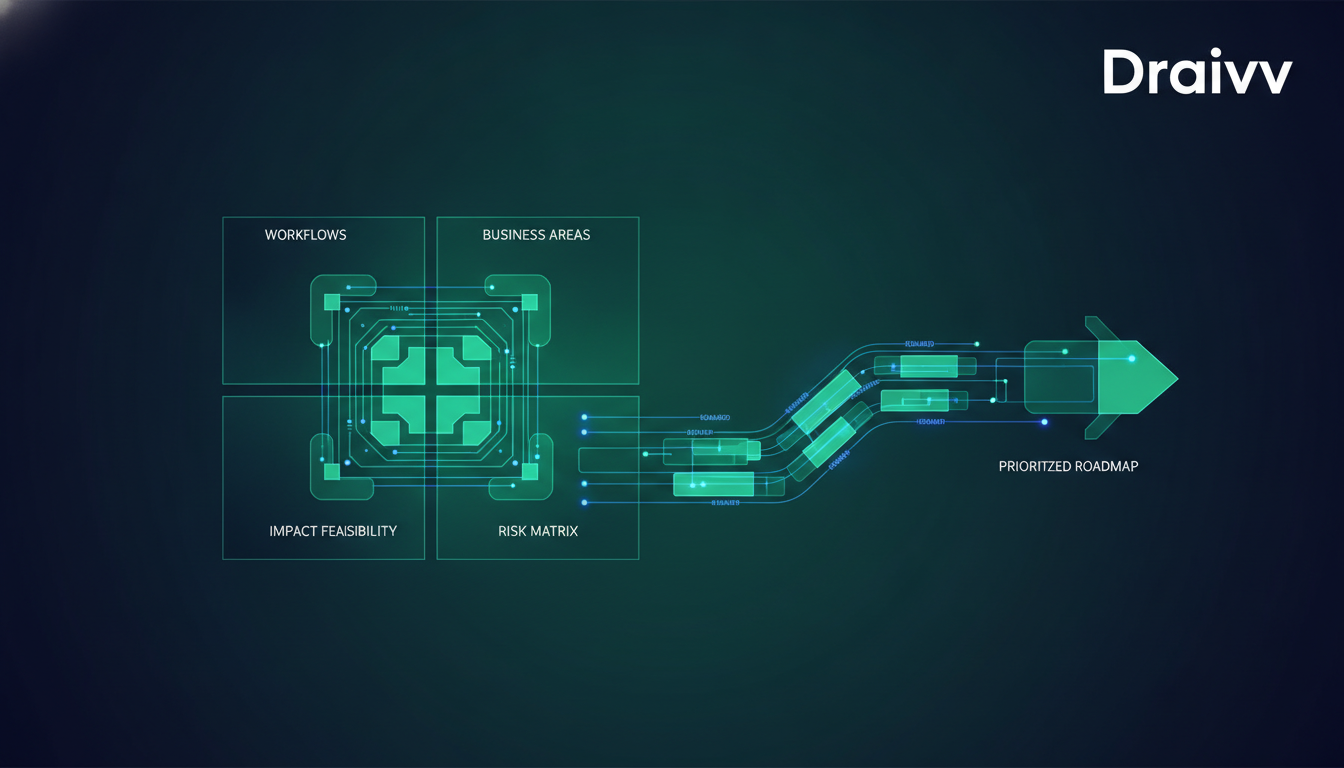
Applying AI with results begins with choosing the right problem, data viability, and a clear business metric. Discover the AI for Business Diagnostic to transform scattered opportunities into a prioritized application roadmap.