


If your company has hired a B2B marketing agency and reports still revolve around impressions, clicks, and reach, the problem is rarely campaign execution. It’s that campaigns were never what was missing. What’s missing is a connection between what marketing produces and what the sales team can actually close.
What Is a B2B Marketing Agency
A B2B marketing agency structures and executes customer acquisition for companies that sell to other businesses, characterized by longer sales cycles, higher ticket values, and purchasing decisions distributed among multiple stakeholders. This changes what needs to be delivered: it’s not about generating traffic volume; it’s about generating pipeline that sales can convert, which we’ve already detailed in B2B Customer Acquisition with AI: How to Structure the Complete Journey.
| Traditional Agency | Integrated Model |
|---|---|
| Marketing separate from sales | Integrated strategy between both areas |
| Media reports (CPC, CTR) | Business metrics (CAC, pipeline) |
| AI as internal productivity | AI applied to client operations |
| Delivery by isolated channel | Delivery connected to results |
Most agencies originate from a single side: they come from communications and learn technology later, or they come from technology and learn marketing later. Both paths leave a gap exactly where strategy, data, and execution should meet, and it is precisely this gap that often hinders the progression from lead to opportunity, as we showed in B2B Sales Funnel with AI: From Market Intelligence to Conversion.
Signs It’s Time to Change Agencies
You likely recognize at least one of these signs: high volume of leads, but without real commercial fit; internal team too small to cover strategy and execution simultaneously; marketing and sales disagreeing on what counts as a qualified lead; CAC rising without clear explanation; strategy that seems the same regardless of the client’s industry.
According to Atendare’s 2026 B2B Marketing and Sales Outlook, 69.2% of Brazilian companies already use AI in some form in their commercial operations, but lead generation remains the main challenge for 39.1% of them, and 28% still sell without a formal qualification methodology. In other words: adopting tools hasn’t solved the underlying problem for most of the market, suggesting that the bottleneck is rarely a lack of technology. This is the same pattern we’ve seen in B2B Lead Generation with AI: How Qualification Works: more volume doesn’t solve it, better prioritization does.
The 4 Pillars for Choosing a B2B Agency
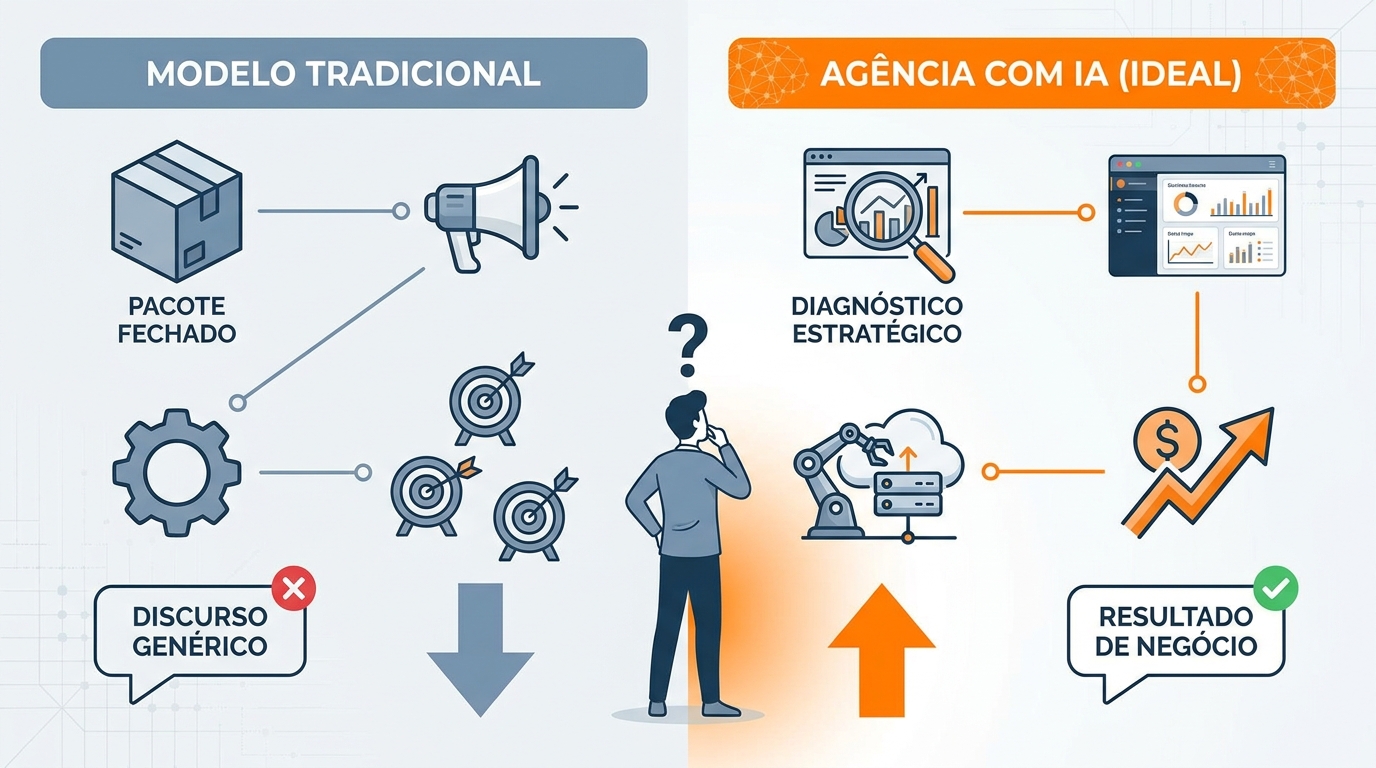 There’s a practical way to evaluate any agency before hiring, regardless of their sales pitch.
- Strategy: Is there a diagnosis before the proposal, or does the agency arrive selling a fixed package? Diagnosis requires understanding the business first; a fixed package assumes every client has the same problem. This is the same reasoning behind Growth Strategy with AI: How to Structure Before Scaling: structure always comes before scale.
- Data: Is the decision based on real operational data, or on generic market best practices? Best practices are a reasonable starting point but become a problem when they completely replace the analysis of that specific business.
- Technology: Are AI and automation part of how the client’s operation functions, or are they just internal agency productivity tools? The difference shows in the delivered results, not in the discourse about the tool.
- Execution: Is delivery done by isolated channels, each with its own goal, or is it connected to a single business outcome? A channel can hit its goal, but the business might not grow if that goal isn’t tied to the pipeline.
No Technology Corrects a Poor Diagnosis
This is the point that most separates a B2B marketing project that works from one that doesn’t: implementing AI into a process that didn’t make sense manually only produces the bad process faster. The technology applied at each stage must be chosen after understanding the problem of that stage, never before.
If the goal is to grow through organic search, Draivv's B2B SEO follows this order: search research and technical foundation first, content second, with leads measured per page.
Common Mistakes When Choosing a B2B Agency
Get the next articles by email
New content from Draivv, straight to your inbox. No spam.
| Mistake | Consequence |
|---|---|
| Hiring by channel portfolio, not by method | Agency strong in media without a qualification process |
| Accepting vanity metrics as success indicators | Activity report, not business impact report |
| Accepting “we use AI” without context | No clarity on where and to solve which bottleneck |
| Changing agencies without changing selection criteria | Same unsatisfactory result, different vendor |
How to Apply This to Your Operation
The question that determines whether it’s worth changing agencies isn’t “how many channels do they cover,” it’s “can they show me, with data, where the bottleneck is before proposing a solution.” If the answer is generic, the problem will likely repeat with the next vendor too.
For companies that have tried several agencies without consistent results, the path usually starts with a diagnosis, not by hiring yet another service package. B2B Inbound with SEO and GEO connects this diagnosis to a continuous acquisition operation.
Learn more about Draivv!
Frequently Asked Questions
What is the difference between a B2B marketing agency and a traditional marketing agency?
A B2B agency works with longer sales cycles, higher ticket values, and purchasing decisions distributed among multiple stakeholders. This changes the metric of success: it’s not about traffic volume; it’s about qualified pipeline that sales can convert.
Is it worth hiring a B2B marketing agency with AI?
It’s worth it when AI is applied to a real and measurable operational bottleneck, such as lead qualification or personalized outreach at scale. It’s not worth it when AI is only used to produce more content faster, without a connection to what’s hindering the funnel.
How do I know if my current agency is delivering business results?
The most direct test is to compare two reports: one for media (impressions, clicks, CPC) and one for business (CAC, pipeline generated, conversion rate). If only the first exists, the agency is reporting activity, not impact.