

Automating a process is easy to sell and hard to deliver.
The easy part is the demo: a tool reads a document, fills a field, sends an email. The hard part appears three months later, when the automated process needs to coexist with exceptions, changing integrations, people entering and leaving the flow, and a volume that's no longer just the pilot's.
The difference between these two moments rarely lies in the chosen technology. It's in how the project was conducted — whether it started from the process or the tool, if it had architecture before implementation, and if it was treated as a one-time delivery or an evolving operation.
This article describes how an enterprise automation project with AI should work from architecture to production, regardless of who executes it. Only at the end does it show how Draivv applies this logic.
When to Hire an Automation Company
Before choosing a vendor, it's worth checking if your operation already shows the signs that justify the investment. Automation solves problems of repetition and coordination — it doesn't solve strategic problems or poorly defined processes.
The most reliable signs:
- Repetitive manual processes. Tasks with digital input, recognizable rules, and verifiable output, executed dozens or hundreds of times per month.
- Operations grow without the team growing with them. Volume has increased, the team hasn't, and the difference is being absorbed by overtime and backlogs.
- Recurring rework. The same error reappears at predictable points in the flow, usually in data transcription, verification, or consolidation.
- Manual integration between systems. Someone exports from one system, adjusts in a spreadsheet, and imports into another. This is the most direct symptom of pending automation.
- Bottlenecks between departments. Process time isn't within the steps; it's in the transitions — a request stalled, waiting for someone to notice it arrived.
If none of these signs appear clearly, the problem is likely not automation. It could be process design, responsibility definition, or prioritization — and none of these improve by adding a layer of technology on top.
How a Good Automation Project Should Be Conducted
This section is vendor-agnostic. It's what you should expect from any serious automation company, including those that are not Draivv.
1. Process Diagnosis Before Any Tool
The starting point is understanding the real process — not the documented one. Mapping steps, volumes, exceptions, involved systems, who decides what, and where time is effectively lost.
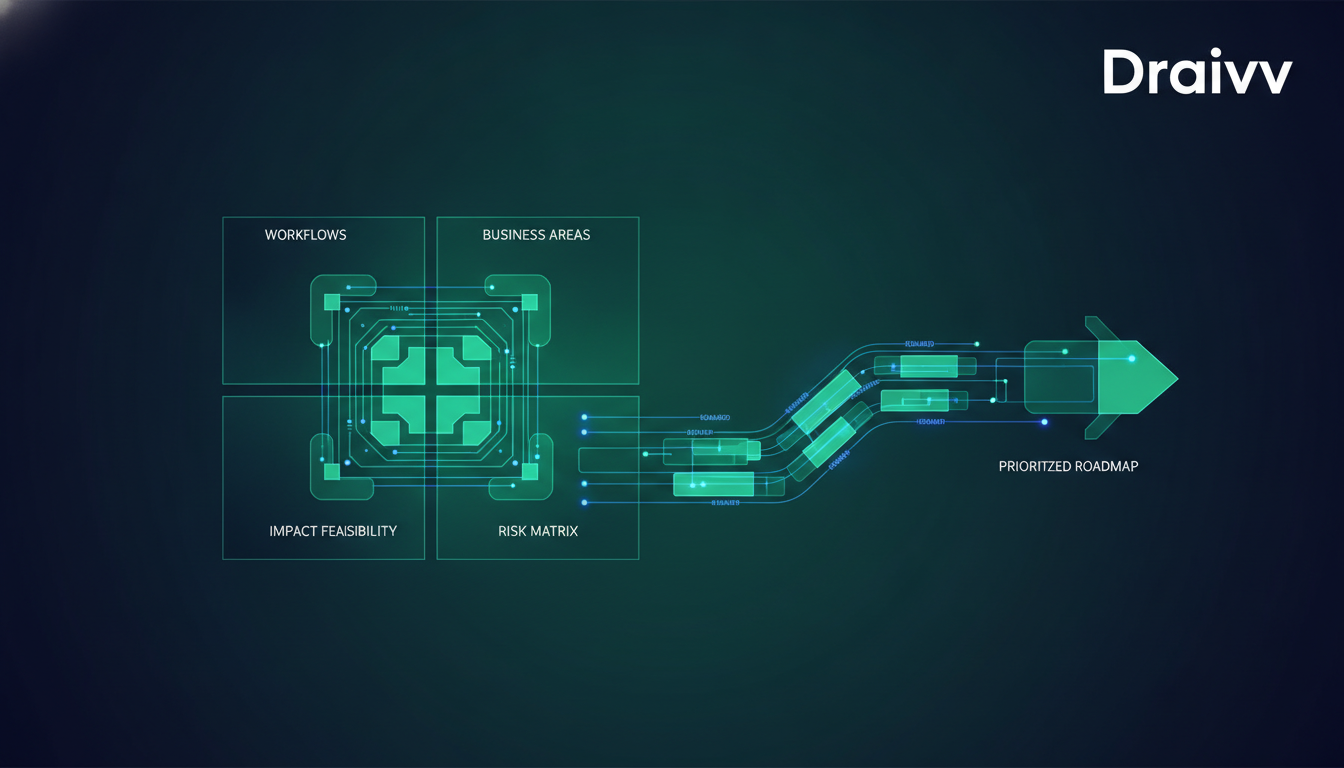
This stage deserves its own article, and it has one: the AI diagnosis for companies details how to map processes, transform bottlenecks into use cases, and prioritize by impact, feasibility, data, and risk. Here, the essential is enough: without diagnosis, automation is born betting on which problem to solve.
2. Solution Architecture Before Implementation
Architecture is the decision of how the automated process will work — which steps are deterministic and which depend on judgment, where a language model fits and where a simple rule fits, which systems are sources of truth, what happens when something fails, and at what points a person needs to approve.
It's the most skipped and most expensive stage to skip. A project without architecture discovers in production that it doesn't know what to do with an exception — and the improvised response is usually to return everything to the manual process.
Three architectural decisions define the rest of the project:
- Where AI fits and where it doesn't. Not every step benefits from a generative model. Format validation, calculation, and rule-based routing are cheaper, faster, and more auditable without AI.
- Where the context comes from. A model only responds well about the company if it has access to the company's knowledge. The choice between retrieving information from an internal database or training a specific model is structural — the comparison between RAG and fine-tuning addresses this decision in detail.
- How the output is verified. If no one can tell if the result is correct, there's no way to operate in production or improve. Verifiability is an architectural requirement, not an optional feature.
3. Controlled Pilot Before Scaling
The pilot exists to test a hypothesis with a narrow scope: one process, one group of users, a sample, a baseline metric, and an explicit criterion for proceeding or stopping.
A pilot without a baseline metric is not a pilot — it's a demonstration. If the company doesn't know how long the process took before, it won't be able to claim it improved afterward.
For flows involving generative models, quality needs to be measured continuously and systematically, not by impression. This is what the guide on AI Evals in production develops: test sets, acceptance criteria, monitoring, and human review at critical points.
4. Production with Continuous Evolution
Automation is not a finished work. Processes change, systems are updated, business rules alter, and volume varies. An automated flow without maintenance degrades silently — it keeps running, producing increasingly worse results, until someone notices.
Mature production has monitoring (someone knows when the flow fails), documentation (someone can make changes without archaeology), a named responsible party, and a review cycle.
What Separates the Two Types of Projects
| Tool-Centric Project | Process-Centric Project |
|---|---|
| Starts with available technology | Starts with the business problem |
| Automates isolated tasks | Redesigns complete workflows |
| Emphasis on implementation | Emphasis on operational results |
| Success = tool live | Success = process indicator improved |
| Exception is the client's problem | Exception is part of the design |
| One-time delivery | Continuous evolution |
The left column doesn't describe bad vendors. It describes an approach choice that works well when the problem is simple and standardized — and fails when the process is company-specific, which is precisely when you hire someone.
How Draivv Conducts an Automation Project
The logic above is the method. What Draivv adds is the applied sequence and the deliverables for each stage.
The Cycle: Diagnose → Architect → Implement → Evolve
Diagnose. Process mapping, bottlenecks, data, and systems, resulting in a prioritized portfolio of opportunities — not a wish list. This is the scope of the AI for Business Diagnosis.
Architect. Solution design: flow, decision points, integrations, context source, exception handling, human supervision, and metrics. The architecture is delivered as a document before any code exists.
Implement. Controlled pilot with baseline metrics, then expansion. Implementation follows the approved architecture — scope changes return to architecture, they are not silently absorbed.
Evolve. Production with monitoring, documentation, and a review cycle. The flow continues to be adjusted as the real process changes.
Illustrative Timeline
A medium-scope project typically distributes as follows. This is not a rule: processes with many integrations or dispersed data extend the initial phases.
| Period | Phase |
|---|---|
| Weeks 1–2 | Process Diagnosis |
| Weeks 3–4 | Solution Architecture |
| Weeks 5–8 | Controlled Pilot |
| Weeks 9–12 | Production Rollout |
Get the next articles by email
New content from Draivv, straight to your inbox. No spam.
Deliverables per Stage
What the company receives — and therefore what it can demand — in each phase:
| Stage | Deliverable |
|---|---|
| Diagnosis | Process map, prioritized bottlenecks, and described use cases |
| Architecture | Solution design, integrations, exception handling, and defined metrics |
| Pilot | Automated process validated with measured results against baseline |
| Production | Operational flow, active monitoring, and maintenance documentation |
An automation project that cannot name the deliverable for each phase is a project that can only be evaluated at the end. This transfers all risk to the buyer.
What Differentiates One Automation Company from Another
The technical capability to connect systems and call models is increasingly available. Automation tools and language models are, to a large extent, the same for everyone — and this commoditization trend is deepening.
What doesn't commoditize is process understanding. Knowing which exceptions matter, where human judgment is irreplaceable, which metric truly represents business results, and how automation behaves when volume triples — this comes from operating, not installing.
It's the same logic that appears in the decision to build or buy AI software and why custom software has become relevant again: when execution becomes cheap, the differentiator shifts to criteria.
Common Hiring Mistakes
Choosing a vendor by their tool. The question "which platform do you work with?" precedes the right question, which is "how do you figure out which process to automate first?". A vendor who answers the first with enthusiasm and the second vaguely is selling implementation.
Treating the pilot as the final product. A pilot runs under controlled conditions: lower volume, selected users, rare exceptions. Putting it into production without addressing exceptions, monitoring, and scale is postponing the problem to the worst possible moment.
Ignoring the continuous support plan. A contract that ends upon delivery leaves the company with an automated flow that no one maintains. In six months, someone will turn it off.
Automating before standardizing. If a process is executed in three different ways by three different people, automating it freezes one of the three — probably the wrong one. Standardization comes first.
Buying too much autonomy too soon. Flows with automatic decision-making without supervision seem more advanced and are riskier. The mature path begins with agents suggesting and humans approving, and only then expands autonomy where history justifies it.
Frequently Asked Questions
What is the difference between enterprise automation and AI automation?
Traditional automation executes deterministic rules: if field A has value X, do Y. It works well in structured processes and fails when input varies. AI automation adds the ability to interpret unstructured input — documents, emails, conversations — and handle variation. In practice, mature projects combine both: rules where there are rules, models where there is ambiguity.
How long does an enterprise automation project take?
A medium scope, with a well-defined process, usually takes 8 to 12 weeks from diagnosis to production. Processes with many integrations, data dispersed across systems, or regulatory requirements extend the initial phases. Much shorter timelines usually indicate that the architecture stage was suppressed.
How to measure the ROI of an automation project?
Compare against a baseline measured before the start: process cycle time, rework rate, cost per transaction, capacity met without increasing staff. Include in the cost not only implementation but also the remaining human review and maintenance. A project without a baseline cannot prove ROI.
Do current systems need to be replaced for automation?
In most cases, no. Much of the gain comes precisely from connecting existing systems that are currently integrated manually. System replacement is a different project, with its own risks and costs, and should rarely be a prerequisite for automation.
Where should AI automation not be applied?
In low-volume processes, in decisions without verifiable criteria, and in flows that affect rights — credit, employment, health — without prior legal and risk assessment. It should also not be applied as a substitute for a process that has not yet been defined.
Related Content
- AI Diagnosis for Businesses: Use Cases and Roadmap
- AI for Businesses: The Definitive Implementation Guide for 2026
- AI Agents: What They Are, How They Work, and How to Apply Them
- Build vs. Buy in AI: When to Buy Ready-Made SaaS and When to Build Your Own
- AI Evals: How to Evaluate AI Performance in Production
Further Reading
Next Step with Draivv
Before choosing a tool, it's worth knowing which process to automate first. The AI for Business Diagnosis maps processes, data, and bottlenecks and returns a prioritized portfolio — with defined impact, feasibility, risk, and next steps.