


Have you ever tested AI at some point in your sales operation, perhaps an automatic call summary, or maybe lead scoring, and wondered if it was the beginning of something real or just another tool that would be forgotten in two months? This doubt is reasonable.
Much of what is sold as "AI for sales" today is hype with a fancy name. But some of it isn't, and the difference between the two lies in exactly where AI fits into your process, not in the tool itself.
If your idea of "AI in sales" is still just automated prospecting, it's worth broadening that scope, as it can cover inside sales, pipeline management, forecasting, post-sales, and account expansion. Treating the topic solely as outbound overlooks most of what is already in production in Brazilian commercial operations in 2026, and likely misses the exact point where your operation is stuck.
The Numbers Behind the "Is It Worth It?"
First and foremost, it's worth answering the question that brought you here: does this really work? Gong Labs, the research arm of the revenue intelligence platform Gong, cross-referenced AI usage by salespeople with actual closing rates. Salespeople who use AI to optimize their daily activities close 50% more deals. Those who use AI to inform decisions about opportunities increase closing by 26%. And those who use AI to guide deal progression close 35% more.
This is no small sample: Gong's most recent study, the State of Revenue 2026, surveyed over 3,000 revenue leaders and analyzed 7.1 million opportunities across 3,613 companies. The central finding is that operations with more mature AI adoption are the ones planning to hire more, not the ones planning to lay off staff.
On the other side of the table, the buyer has also changed. In HubSpot's most recent State of Sales, which surveyed over a thousand sales professionals, 74% agree that AI has made it easier for buyers to research even before their first contact with a salesperson. In practice: your prospect has likely already researched your company, compared competitors, and formed an opinion before you even dial. This changes what is expected of the salesperson: from someone who presents a solution to someone who builds confidence in the decision the buyer is already forming independently.
Where to Start: The Draivv Commercial AI Framework
To know where AI makes sense in your operation, a list of tools is less helpful than understanding which of the five stages your operation is currently stuck on. This is the reasoning behind Draivv's Commercial AI Framework: Discover, Prioritize, Personalize, Support, and Predict.
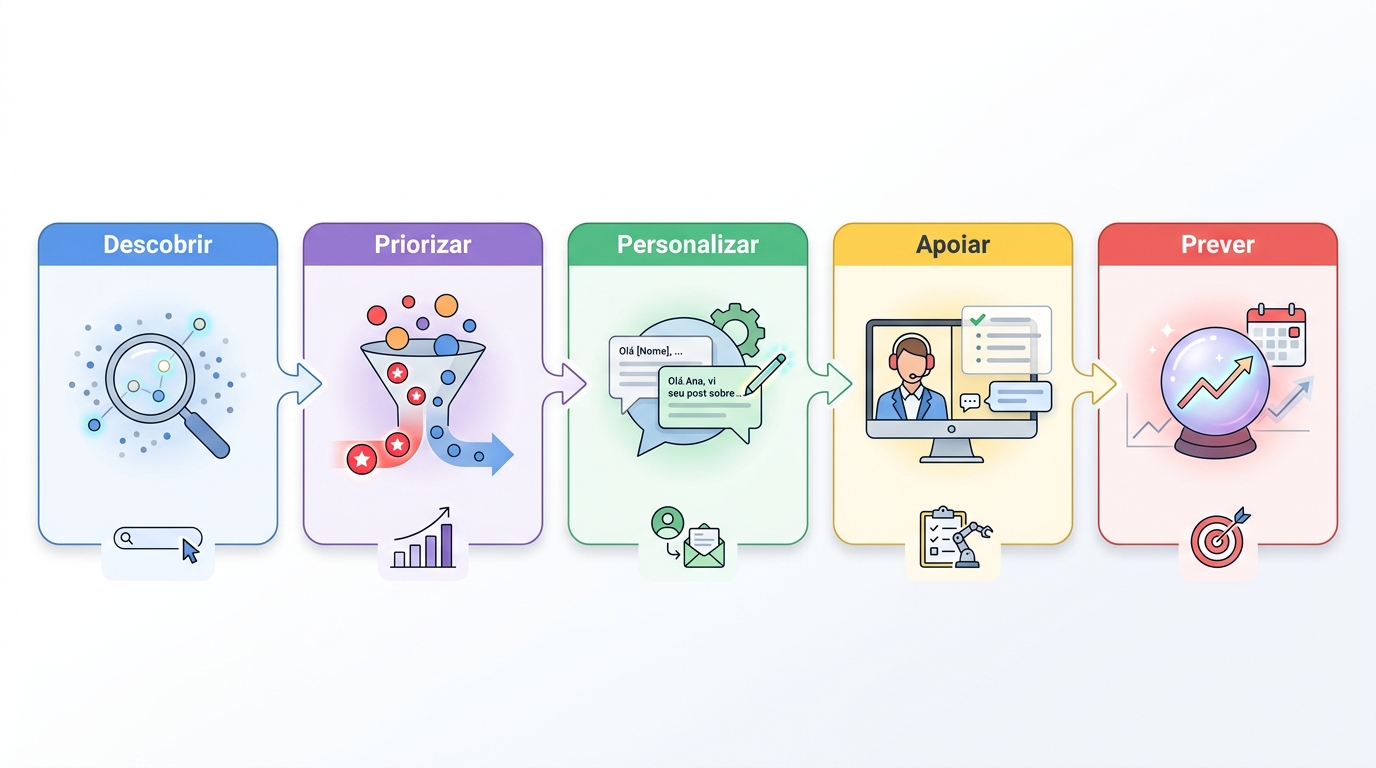 If your team spends time researching each company before outreach, the bottleneck is in Discover. This is the layer of sales intelligence and data enrichment, which captures buying intent signals before the first call.
If every lead receives the same level of attention, from hot to cold, the bottleneck is in Prioritize: predictive lead scoring, which decides based on real behavior which accounts deserve your time first. If you want to understand this topic in more depth, be sure to read our content on "B2B Lead Generation with AI."
If your messages sound generic even with the correct name in the template, the bottleneck is in Personalize, the difference between a standalone {firstName} and real prospect context. We have already covered this in depth in how to structure the B2B customer acquisition journey with AI.
If the salesperson forgets what was agreed upon in the previous call, the bottleneck is in Support. This is the most mature layer in the market today: automatic summaries, extraction of next steps, and real-time assistance during conversations, with tools like Gong, Modjo, and Avoma.
If your forecast never matches what actually closes, the bottleneck is in Predict: pipeline analytics that learns from your company's own historical closed deals, instead of relying on gut estimates. Salesforce and Clari lead this layer.
Worth noting: most operations aren't stuck in just one layer — but there is usually one where the pain is highest now, and that's where it pays to start.
Does the Autonomous SDR Agent Solve Your Case?
If you've come this far thinking about automating all prospecting with an agent that discovers, enriches, personalizes, and schedules without human intervention, the honest answer is: it depends on your product and your sales cycle, not the quality of the tool.
It works well when volume is high, the process is repeatable, and the ICP is already validated, a scenario where the variation between approaching one lead and another is low. It doesn't work when the sale is consultative, the ticket is high, and the cycle extends over months of relationship: in these cases, the buyer expects human interaction from the first contact, and an agent there creates friction instead of trust.
Recent industry guides point to this same limit: contracts above R$ 500,000, or negotiations that depend on reading emotional nuance, still require a human SDR to lead. AI acts as support, not a substitute.
If your sale is of the second type, a full-cycle autonomous agent is probably not the answer, but specific parts of the process (enrichment, call summary, prioritization) are still worthwhile in isolation. To understand the difference between an agent and a chatbot before deciding where to apply, it's worth reading AI Agents: what they are, how they work, and how to apply them in your company.
Get the next articles by email
New content from Draivv, straight to your inbox. No spam.
Where Most Go Wrong
If you've tried AI in sales and it didn't work, it was probably for one of these reasons, and recognizing which one applies to you is more valuable than any list of new tools:
- Copying and pasting generic prompts without adapting to the real context of the company and the prospect's industry.
- Automating personalization and prospecting before defining the ICP: AI scales what already exists, including the mistake of targeting the wrong audience.
- Blindly trusting automatic lead scoring, without periodic human review of the model.
- Letting strategic messages (large deals, key accounts) go out without human review before sending.
- Letting ChatGPT write your emails without any real layer of personalization: the recipient recognizes the pattern, and the response rate drops instead of rising.
The Point No One Tells You Beforehand
If none of this worked despite avoiding the errors above, look at your CRM before looking at the AI model. AI learns from the available data: incomplete, outdated, or poorly cleaned CRM history generates unreliable recommendations, no matter how sophisticated the tool behind it.
How to Know if It Worked
Define what "worked" means for your operation beforehand, or it will be impossible to know whether to continue investing. The metrics that truly capture the effect:
- Response rate and meeting scheduling rate
- Conversion rate from qualified lead to opportunity
- Average time to qualify a lead
- Pipeline coverage and win rate
How to Start Without Turning Your Operation Upside Down
You don't need to restructure everything at once. Three low-risk moves to test where your operation gains the most across the five framework points:
- Automated call summary with next-step extraction, reducing rework without touching the qualification process.
- Scoring historical leads with a simple model, to validate the logic before automating prioritization in production.
- First-layer personalization assisted by an agent, with human review maintained before sending.
Using AI in prospecting and commercial communication in Brazil involves LGPD (Brazilian General Data Protection Law), opt-out, and transparency with the prospect about the use of AI in interaction. This should be incorporated into the process design from the outset, along with ICP and tool selection, not afterward.
How to Apply the Draivv Commercial AI Framework to Your Operation
Reread the five questions in the framework section: which one describes your operation today? That's where AI has the best chance of generating real returns, and that's where it pays to start, before testing any new tools. The five layers only work in conjunction: automating one without structuring the others only moves the bottleneck to another point in the funnel.
To apply this to your company's prospecting, see Draivv's B2B lead generation: ideal customer profile, verified decision-makers and outreach by email, LinkedIn and phone, with every lead logged in the CRM.
Visit the Draivv website!