

Most companies don't suffer from a lack of artificial intelligence ideas. They suffer from an excess of them.
Internal assistants, customer service, document analysis, content generation, forecasting, agents, automation, and copilots all compete for the same budget. Without clear criteria, organizations often choose the most visible case, the most talked-about tool, or the project championed by the most influential department.
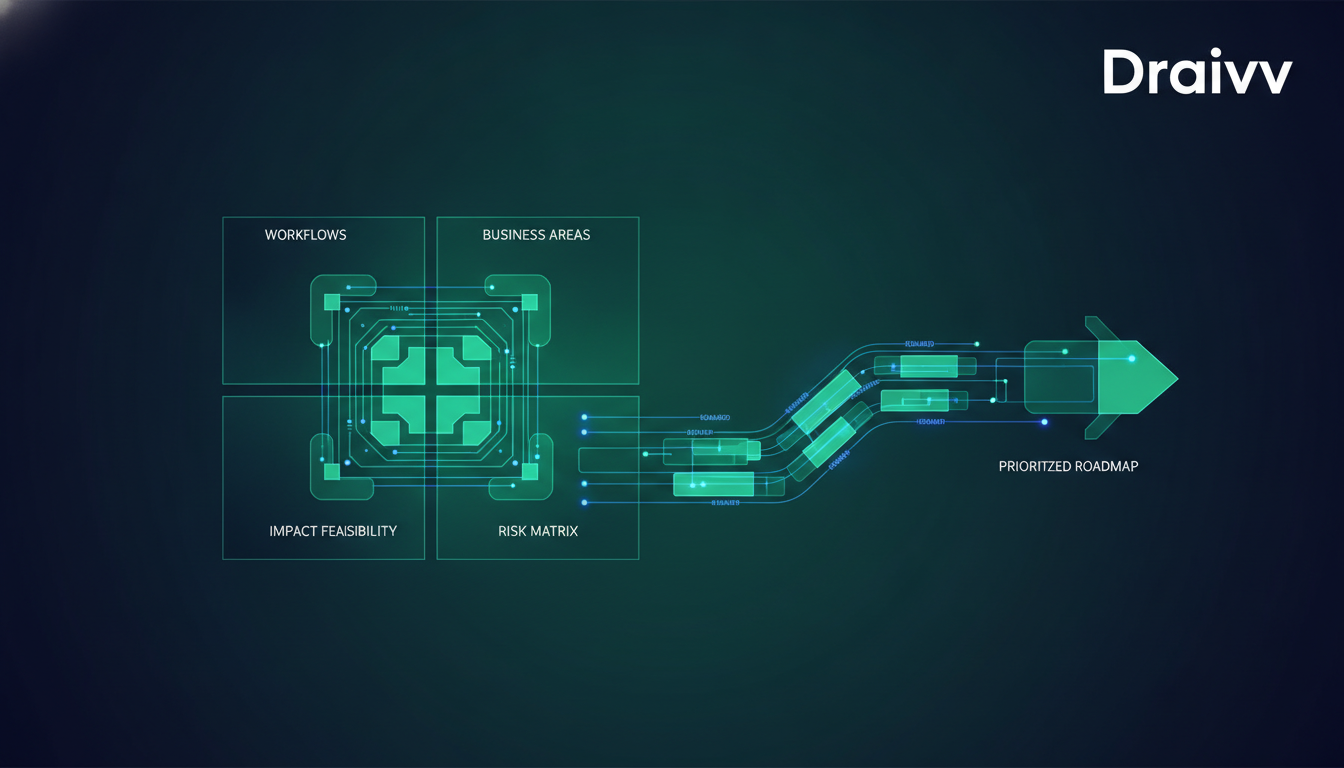
An AI diagnosis organizes this demand. It identifies where impact can be made, verifies if data and processes support implementation, assesses risk, and produces a roadmap connected to business metrics.
What is an AI Diagnosis?
An AI diagnosis is a structured evaluation of processes, problems, data, technology, risk, and organizational capacity.
The goal isn't to answer “which tool should we buy?” It's to answer:
- where AI can generate real value;
- which cases are viable now;
- which depend on preparation;
- which risks need to be addressed;
- what to buy, integrate, or build;
- how to measure results;
- which sequence reduces risk and accelerates learning.
The diagnosis transforms a list of possibilities into prioritized decisions.
Why Starting with the Tool Often Goes Wrong
A tool demonstrates generic capability. A company needs to solve a specific problem within a real process.
The same chatbot might be useful in one operation and irrelevant in another. An agent might reduce time in a well-defined workflow but amplify errors in a process without rules, a knowledge base, or supervision.
Projects fail when:
- the problem lacks sufficient value;
- there's no sufficient volume or repetition;
- data is fragmented;
- the output cannot be verified;
- integration is more complex than the benefit;
- users don't participate in the design;
- there's no process owner;
- the pilot lacks metrics;
- security and governance are introduced too late.
The initial question needs to be about the process, not the model.
Step 1: Map Processes and Bottlenecks
The diagnosis begins with interviews and observation of routines.
For each process, record:
- objective;
- steps;
- people involved;
- systems;
- inputs and outputs;
- volume;
- time spent;
- rework;
- errors;
- dependencies;
- decisions;
- rules;
- exceptions;
- available data;
- impact on customer, revenue, or cost.
Recurring bottlenecks are better candidates than sporadic activities. Processes with digital input, recognizable patterns, and verifiable output tend to allow for more controllable pilots.
Step 2: Transform Bottlenecks into Use Cases
A use case needs to be described as an operational change.
Instead of “using AI in customer service,” formulate:
Classify incoming requests, retrieve approved answers from the knowledge base, suggest a response, and escalate exceptions to a human agent.
Instead of “using AI in sales”:
Research ICP accounts, identify relevant signals, summarize context, and support approach preparation, maintaining human approval before contact.
A good description includes:
- user;
- input event;
- task;
- data;
- decision or output;
- integration;
- supervision;
- metric;
- boundaries.
Step 3: Prioritize by Impact, Feasibility, Data, and Risk
Draivv recommends comparing cases using a common matrix.
| Dimension | Question |
|---|---|
| Impact | How much can time, cost, quality, or revenue improve? |
| Frequency | Does the process occur with sufficient volume? |
| Feasibility | Can models and integrations perform the task? |
| Data | Is data accessible, reliable, and authorized? |
| Verifiability | Is it possible to assess if the output is correct? |
| Risk | What is the potential damage from error or misuse? |
| Adoption | Are users and stakeholders available? |
| Time to Value | How long until a real result can be measured? |
A score from 1 to 5 helps with comparison. Impact and frequency can increase priority. Risk, low data quality, and complex integration can reduce it.
Quick Wins
Cases with reasonable impact, available data, verifiable output, and low risk. These are good candidates for pilots.
Strategic Bets
Cases with high impact but greater complexity. They require discovery, data, integration, and governance before going into production.
Necessary Preparation
The problem is relevant, but data or processes are not yet mature. The roadmap should include preparation.
Low Priority
Cases with little value, low frequency, or disproportionate risk. These should be de-prioritized.
Use Cases by Area
Sales
- account research and enrichment;
- signal identification;
- meeting preparation;
- CRM summary;
- proposal support;
- conversation analysis;
- forecasting and prioritization.
Marketing
- market research;
- content architecture;
- editorial repurposing;
- performance analysis;
- personalization;
- brand monitoring;
- SEO and GEO.
Customer Service
- classification;
- knowledge retrieval;
- response suggestion;
- summarization;
- quality control;
- intent and urgency identification.
Operations
- document reading;
- reconciliation;
- data extraction;
- exception monitoring;
- report generation;
- assistance in repetitive decisions.
Human Resources
- internal policy search;
- employee support;
- competency description and organization;
- document analysis;
- learning and development.
Sensitive areas, such as employment, credit, health, and decisions with an impact on rights, require in-depth legal and risk assessment.
Get the next articles by email
New content from Draivv, straight to your inbox. No spam.
Step 4: Decide Between Buying, Integrating, or Building
Each case can follow different paths.
Buying tends to work when the process is standardized and the solution meets requirements without deep integration.
Integrating makes sense when the company needs to connect models and tools to its own systems, databases, and rules.
Building may be appropriate when the process is central, the data is proprietary, and the logic represents a competitive differentiator.
The article on Build vs. Buy in AI delves deeper into this decision. For corporate knowledge, it's also important to evaluate RAG versus fine-tuning.
Step 5: Define the Pilot
A pilot should test a hypothesis with a limited scope.
Define:
- process and user;
- sample;
- baseline metric;
- expected outcome;
- test cases;
- quality criteria;
- human supervision;
- boundaries;
- owner;
- cost;
- duration;
- condition for advancement.
For generative systems, quality needs to be measured continuously. The AI Evals guide presents ways to evaluate performance in production.
Step 6: Build the Roadmap
A 90-day roadmap can be organized as follows:
Phase 1 — Discovery and Preparation
- interviews;
- process inventory;
- data evaluation;
- risk analysis;
- case selection;
- initial architecture.
Phase 2 — Pilot
- prototype;
- minimal integration;
- test set;
- controlled users;
- measurement;
- corrections.
Phase 3 — Controlled Production
- controls;
- monitoring;
- documentation;
- training;
- access management;
- contingency plan.
Phase 4 — Scale
- new users;
- new workflows;
- additional automation;
- integration;
- cost review;
- continuous governance.
The sequence should depend on the evidence produced, not a rigid calendar.
AI in Europe: Adoption and Responsibility Advance Together
According to Eurostat, 20% of European Union companies with ten or more employees used AI technologies in 2025, up from 13.5% in 2024. Adoption is growing, but enterprise application is also starting to coexist with clearer obligations.
The European AI Act uses a risk-based approach. Transparency rules have applied since August 2026, while obligations for high-risk systems were postponed to December 2027. Companies operating in Europe need to understand whether they act as providers or users of systems, what risks are involved, and what controls are applicable.
Technical diagnosis does not replace legal analysis but needs to identify personal data, sensitive decisions, transparency, supervision, and documentation early on.
Frequently Asked Questions
Does an AI diagnosis need to involve IT?
Yes, but not only IT. Business areas understand the process and value; IT evaluates integration, security, data, and sustainment.
How many use cases should be on the roadmap?
It's best to start with a few clearly prioritized cases. Too large a portfolio disperses the team and makes it difficult to measure results.
Does every pilot need to use the most advanced model?
No. The appropriate model is one that delivers sufficient quality within cost, latency, security, and integration requirements.
How to calculate AI ROI?
Compare the baseline with results such as time, cost, error, capacity, conversion, or revenue. Include development, integration, human review, and sustainment.
Related Content
- AI for Businesses: Implementation Guide
- AI Agents: How to Apply Them in Your Company
- Build vs. Buy in AI
- AI Evals in Production
Sources for Further Reading
- Eurostat — AI use in European enterprises in 2025
- European Commission — AI Act and application timeline
- NIST — AI Risk Management Framework
Next Step with Draivv
Draivv's AI for Business Diagnosis transforms processes, bottlenecks, and ideas into a prioritized portfolio, complete with initial architecture, risks, metrics, and an implementation roadmap.