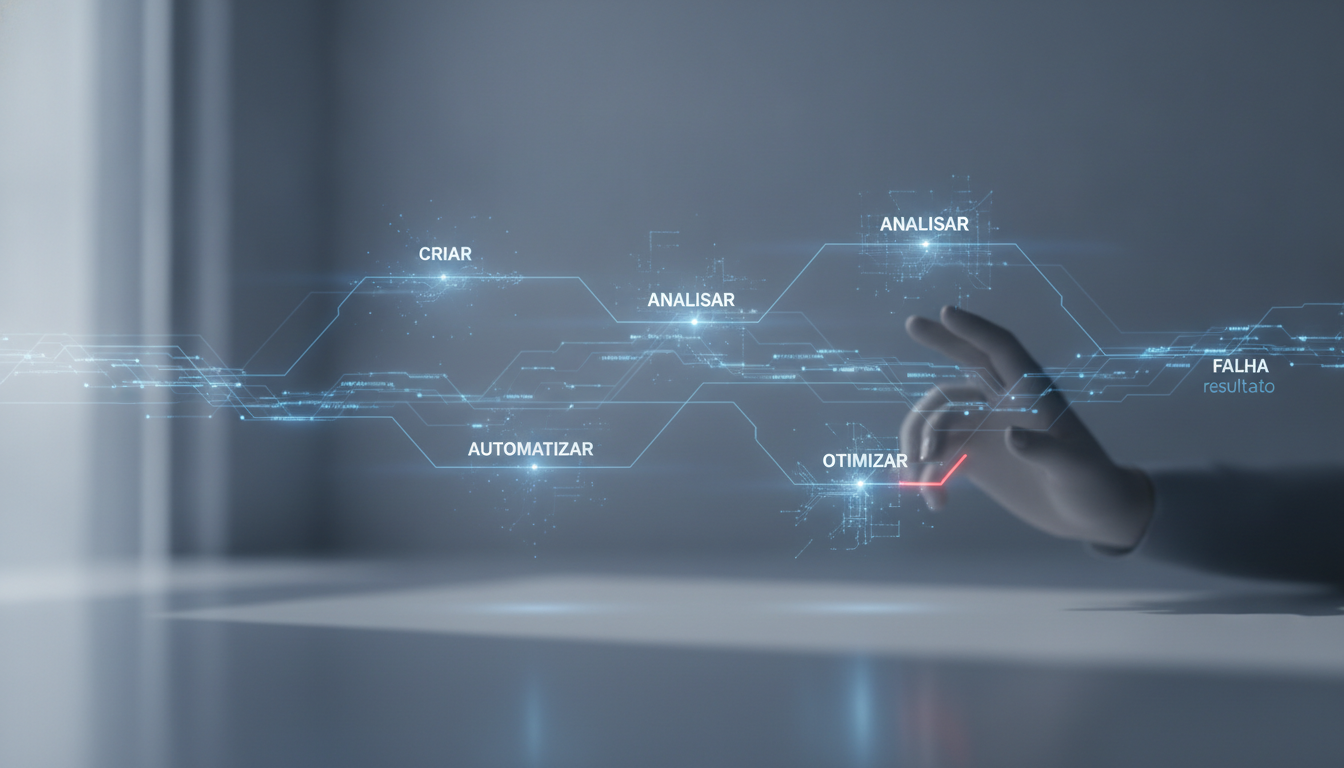

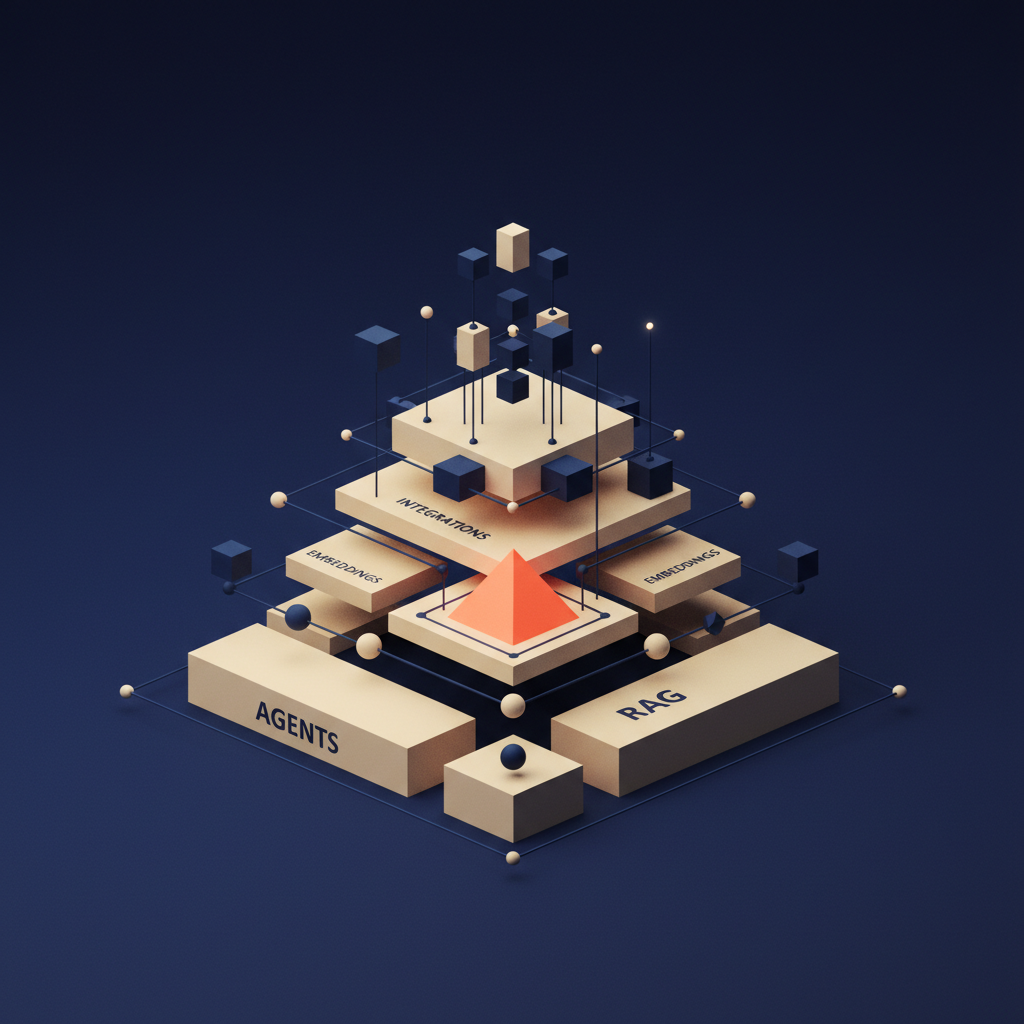
Draivv Rank is Draivv's automated SEO + GEO platform, built on a carefully applied AI stack: Claude (Anthropic) as the generation and editorial review engine, RAG architecture to preserve factual fidelity, specialized agents for each step of the editorial workflow, MCP (Model Context Protocol) as the integration layer, and semantic embeddings to detect cannibalization and refresh opportunities. This article explains the stack — not as a technical showcase, but as a concrete example of AI applied to editorial operations in production.
For months, Draivv has been publishing about AI applied to business — RAG, fine-tuning, agents, MCP, build vs. buy, prompt engineering in production. These topics are not abstract for us: they are the technical decisions we made to build Draivv Rank, the product that powers automated SEO + GEO for B2B companies.
This article opens the hood. Not as a product release note, but as a practical case study on how to combine Claude, RAG, agents, MCP, and embeddings to solve a real editorial problem — producing deep, structured content for generative AI mechanisms, at scale, while maintaining human quality and respecting E-E-A-T.
If you're considering building applied AI into your operations — or evaluating build vs. buy — Draivv Rank is a concrete example of architectural decisions that pay off, and those that don't.
The editorial problem Draivv Rank solves
Before the stack, the problem. B2B companies with deep technical knowledge (consultancies, industries, SaaS, professional services) face a recurring bottleneck:
- They have the knowledge, but not the time to transform it into publishable content.
- They hire agencies, but generic delivery lacks depth.
- They hire freelancers, but inconsistency kills the cluster.
- They try pure AI (direct ChatGPT), but the result is generic and detectable.
Our Draivv Rank addresses this gap with a hybrid editorial pipeline: generative AI for scale + human review for credibility + a platform for technical consistency. It's not "AI writes for you." It's "AI accelerates what you already know how to do, with layers of review and technical publishing that no one does manually."
The architecture: five layers
The Draivv Rank stack combines five layers, each solving a specific problem.
Layer 1 — Research and brief: structured data as a starting point
Before generating any text, the system builds a brief from structured sources:
- DataForSEO for topic volume, difficulty, and SERP (native pt-BR)
- Integrated Google Search Console to identify low-CTR opportunities and already indexed queries
- Google Analytics 4 to understand existing traffic behavior
- Client's semantic database (embeddings) to detect cannibalization with already published content
These inputs feed a structured brief: an outline with h2/h3, suggested FAQ, ICP, editorial angle, and pre-mapped internal links. It's not AI guessing structure. It's AI structuring based on real client data.
Here lies the first relevant architectural decision: we integrate structured APIs (DataForSEO, GSC, GA4) instead of asking AI to "research the web." Why? Because structured sources are auditable. AI searching the web invents statistics. A reliable stack starts with reliable input.
Layer 2 — Generation with Claude: RAG over client knowledge
Text generation uses Claude (Anthropic) as the primary engine. The choice is not accidental.
The generation flow is RAG (Retrieval-Augmented Generation), not pure LLM. Before generating an article section, the system:
- Queries the client's semantic embeddings database.
- Retrieves the most relevant excerpts from the brand kit, fact base, and previous articles.
- Inserts these excerpts as context into the Claude call.
- Asks Claude to write the section based on this specific context, not the internet average.
The practical difference:
- Pure LLM: "Write about RevOps" → generic text, potentially invented facts, impersonal tone.
- RAG over client knowledge: "Write about RevOps using these excerpts from the client's brand kit, these verifiable data points, this real case previously published" → text with brand tone, auditable facts, consistency with the cluster.
Why Claude and not another model? Three reasons: (1) editorial quality in Portuguese surpasses competitors in long-form prose; (2) a long context window (1M tokens in Claude Sonnet 4.6) allows passing brand kit + related articles + brief in a single prompt; (3) ability to follow complex structural instructions (TL;DR + table + FAQ + citations in a specific format).
We detailed the model choice in our Claude vs. ChatGPT comparison and in the Claude family analysis.
Layer 3 — Specialized agents for each step of the editorial workflow
Instead of a single agent that does everything, Draivv Rank uses specialized agents for each step — each with its own prompt, context, and scope:
- Research agent: builds the brief from DataForSEO + GSC + GA4.
- Outline agent: defines h2/h3, FAQ, and linking based on the brief.
- Generation agent: writes section by section with RAG over the brand kit.
- Editorial review agent (auditor): verifies E-E-A-T, citation coverage, depth, tone, internal linking density.
- Technical SEO agent: automatically applies schema, OG, canonical, sitemap.
- Maintenance agent: monitors performance, detects cannibalization, identifies refresh opportunities.
Modularity comes from practice: specialized agents are more accurate than generalists. Each can have an optimized prompt, restricted context (only what's necessary), and an appropriate model (Opus for critical judgment, Sonnet for volume, Haiku for mechanical tasks).
We discussed this architectural choice in AI Agents: What they are, how they work, and how to apply them. Draivv Rank is a practical example: each agent has clear responsibilities, its own tools, and human checkpoints at critical junctures.
Layer 4 — MCP as an integration protocol
The integration between Draivv Rank agents and external tools (DataForSEO, GSC, GA4, embeddings database, WordPress, Shopify) goes through MCP (Model Context Protocol) — Anthropic's open standard adopted by OpenAI, Google, and the enterprise AI community.
Why MCP instead of classic REST integrations?
- Composability: MCP servers are reusable across agents. The server that connects to GSC for the research agent is also used by the maintenance agent.
- Open standard: When the client wants to use Claude Desktop, ChatGPT, or another LLM with the same set of tools, they just point to the same MCP servers.
- Auditability: Each tool call is logged, with verifiable input and output. Critical for editorial operations in production, where we need to trace the origin of every data point.
The decision to adopt MCP was documented in our analysis MCP (Model Context Protocol): Why Anthropic Changed the AI Integration Game. Draivv Rank is one of the practical applications of this choice.
Layer 5 — Semantic embeddings for live maintenance
The difference between a CMS that publishes and a CMS that maintains lies in the fifth layer: continuous semantic embeddings.
Every time content is created or edited, Draivv Rank:
- Generates embeddings of the new text.
- Compares them with embeddings from the client's database.
- Detects cannibalization (articles competing for the same intent).
- Identifies refresh opportunities (old content with declining performance).
- Suggests cluster reorganization when necessary.
Get the next articles by email
New content from Draivv, straight to your inbox. No spam.
This loop transforms the CMS from a "publishing tool" into a "continuous maintenance system" — exactly what SEO + GEO demand in 2026. Without this loop, content decays. With it, the cluster stays alive.
Why this stack is different from "using ChatGPT to write"
The difference between Draivv Rank and the amateur approach ("I'll use ChatGPT to write my articles") is structural, not cosmetic. Summarizing the architectural decisions that matter:
| Decision | Amateur Approach | Draivv Rank |
|---|---|---|
| Research Input | AI inferring | Structured DataForSEO + GSC + GA4 |
| Generation | Pure LLM, single prompt | RAG over client's brand kit |
| Model | Generic | Claude calibrated for pt-BR prose |
| Agent Architecture | One agent doing everything | Specialized agents per stage |
| Integration | Manual copy-paste | MCP between agents and tools |
| Schema and Technical Publishing | Manual or absent | Automatic |
| Maintenance | No one does | Continuous re-embedding, cannibalization detection |
| Human Review | Optional or absent | Mandatory at critical points |
The practical consequence: content generated by Draivv Rank passes tests that pure AI content fails. Google Helpful Content Update does not penalize it. LLMs with browsing cite it (because the content is structured to be citable). And the editorial team maintains real governance — they don't become "prompt operators."
The build vs. buy decision: why we built instead of bought
We discussed build vs. buy in another article — when it makes sense to build and when to use off-the-shelf SaaS. Draivv Rank is our own case: why did we build instead of using Surfer SEO, Frase, or MarketMuse?
Three concrete reasons:
Brazilian specialization. International tools poorly cover pt-BR. Brazilian SERP, local B2B tone, integrations with WordPress dominant in the national market — none of the foreign options deliver this well.
Native GEO from day 1. International tools are adding GEO as an optional module on top of an SEO base. Draivv Rank was designed for both environments from the architecture — TL;DR, FAQ schema-ready, attributed citations are default, not an add-on.
Operation as a product. Surfer/Frase/Clearscope/MarketMuse are editors. Draivv Rank is a complete engine (research + generation + technical publishing + maintenance). To deliver SEO as a Service as a managed service — which is what Draivv does — we need the full cycle.
The build decision was made with an eye on scale: each new client that enters Draivv's managed model amortizes the investment, and the platform improves with each operation (RAG over a larger base, more calibrated agents, more precise pattern detection).
Draivv's role as the engine operator
Draivv Rank is the product. Draivv is the operation that delivers the product as a service in the Brazilian B2B market.
The division is clear:
- Draivv develops and operates Draivv Rank (platform).
- Draivv operates Draivv Rank as SEO as a Service for Brazilian B2B clients.
- The client can choose between self-serve (SaaS subscription, internal team operates) or managed (Draivv operates end-to-end).
This separation reflects reality: not every company wants to operate an SEO + GEO engine internally. Some prefer to outsource the editorial calendar and focus on their core business. For these, Draivv exists — and Draivv Rank is the engine behind it.
Conclusion: Applied AI is not pure AI
The central lesson from this project, after months of building and operating Draivv Rank, is simple: applied AI in production is not "using ChatGPT." It's architecture.
RAG to preserve fidelity. Specialized agents for accuracy at each stage. MCP for standardized integration. Embeddings for maintenance. Human review at critical points. All of this operates together, with discernment, generating measurable results that pure AI cannot deliver.
For companies considering build vs. buy in AI, Draivv Rank is a concrete example of the second option (build) — and the discipline required to make it succeed. For companies that prefer to buy, Draivv Rank is available as self-serve SaaS or as a managed service via Draivv.
The question is not whether AI will change how your company operates. It's what architectural decisions you will make to ensure that the change is sustainable.
Draivv develops and operates Draivv Rank, an automated SEO and GEO platform. In the Brazilian B2B market, the engine is operated by Draivv as a managed service and available in a self-serve model for internal teams. Learn more about Draivv's operations or continue reading our stack:
Related content
This article connects with the rest of our series on applied AI for businesses:
- SEO + GEO in 2026: Why AI Changed the Search Game — the problem Draivv Rank solves
- AI Agents: What they are, how they work, and how to apply them — the architecture behind Draivv Rank agents
- MCP (Model Context Protocol) — the integration protocol we use
- RAG vs. Fine-tuning: When to use each — the decision for RAG in Draivv Rank
- Claude vs. ChatGPT in 2026 — why Claude
- Claude Sonnet, Opus, and Haiku: Which model for which task — models for each stage of the workflow
- Build vs. Buy in AI — the decision to build Draivv Rank
- Custom Software in the AI Era — the broader context of this decision
- Prompt Engineering for Businesses — technical fundamentals
- How to Use Claude for SEO Without Constant Spreadsheet Uploads — the same principle applied to an SEO analyst's routine
Next step with Draivv
If your company needs to transform its digital presence into a continuous system of discovery and demand, explore B2B Inbound with SEO and GEO and see how Draivv Rank connects research, production, publishing, and monitoring.