
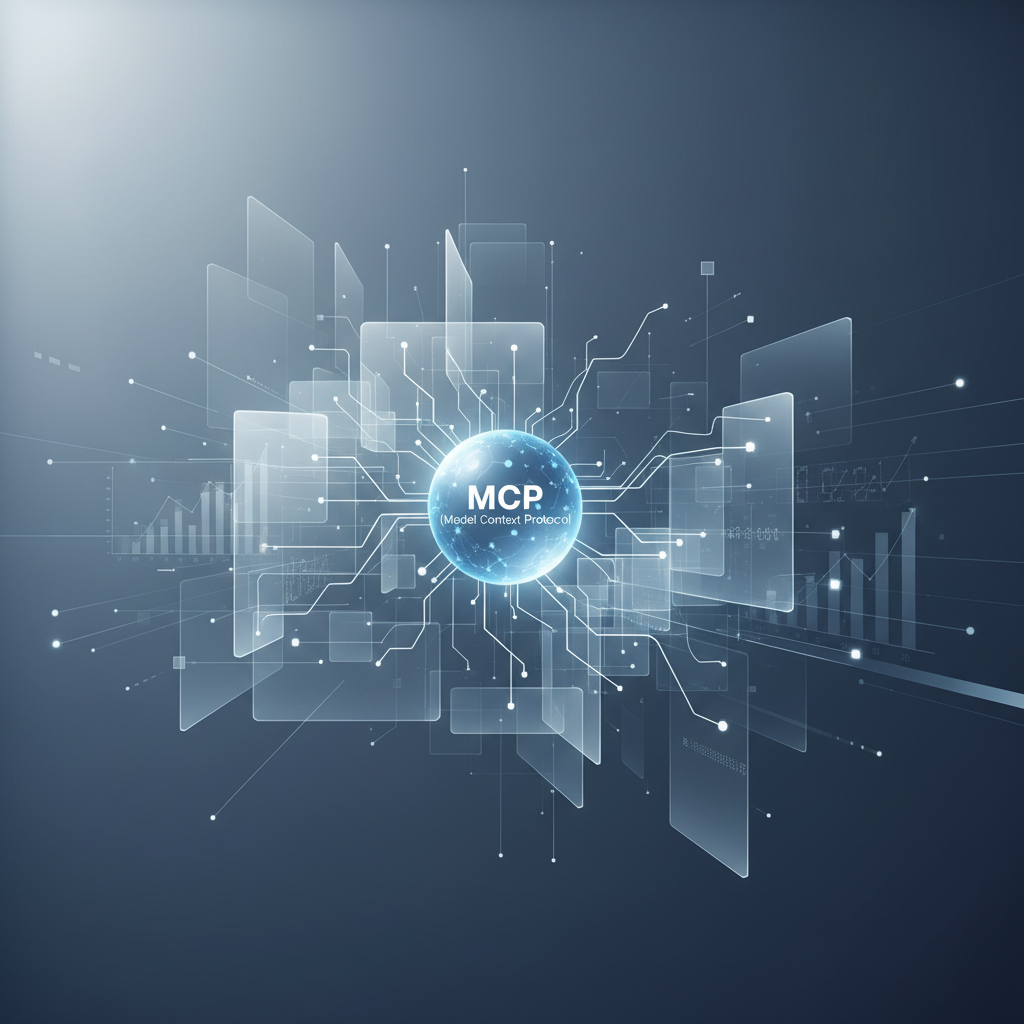
The adoption of the Model Context Protocol (MCP) by Anthropic in just 16 months, surpassing 97 million monthly SDK downloads by March 2026, has redefined AI integration in enterprise systems. What once required custom connections between each model and each tool now has a common path, with direct implications for cost, maintenance, and scale.
Launched by Anthropic in November 2024 as an open standard for connecting AI assistants to data systems, MCP quickly moved from a technical proposal to market infrastructure. The speed helps explain why: according to research sources, Kubernetes took almost four years to reach comparable scale, while MCP achieved it in 16 months.
The Bottleneck Was No Longer the Model. It Was Integration
Before MCP, each connection between an AI application and an external tool required custom integration. In practice, this created fragile dependency chains, increased maintenance costs, and made it difficult to scale AI agents in production.
An analysis published in the Forbes Technology Council summarizes this point directly: “MCP collapses the problem of fragile dependency chains and escalating maintenance costs, making the scalability of AI agents practical for most organizations.”
This is the core of the change. The protocol acts as a universal adapter layer, allowing any AI model to communicate with any tool through a single interface. For operations already working with multiple systems, this reduces a structural bottleneck: the need to re-implement integrations whenever the model, tool, or workflow changes.
The technical proposal also helped accelerate adoption. MCP uses JSON-RPC over standard transports, with compatible support for any language and runtime. Instead of tying the architecture to a specific stack, the protocol reduces implementation barriers and facilitates interoperability between different environments.
Anthropic's Decision Accelerated Standard Consolidation
Anthropic not only launched MCP in November 2024 but also immediately open-sourced it under an MIT license, with no fees or restrictions, and provided reference implementations for common tools like GitHub, Slack, Postgres, and Google Drive.
This initial design matters because it shortened the distance between specification and actual use. Instead of relying solely on documentation, the market received an open protocol with concrete implementation examples from the outset.
The consolidation of MCP as a market standard began to materialize with its adoption by direct competitors. OpenAI integrated the protocol in early 2025, and Google followed suit in early 2026. Today, Claude, ChatGPT, Google Gemini, Cursor, Windsurf, VS Code, JetBrains AI Assistant, and Microsoft Copilot support MCP as clients. On the server side, Google Drive, Slack, Notion, GitHub, Jira, Salesforce, and Postgres already have MCP implementations.
In December 2025, Anthropic took another decisive step by donating MCP to the Linux Foundation, establishing its governance under the Agentic AI Foundation (AAIF). The foundation's co-founders include Anthropic, Block, and OpenAI, with support from AWS, Google, Microsoft, Cloudflare, and Bloomberg.
Mike Krieger, CPO at Anthropic, summarized the significance of this move: “The protocol has become critical infrastructure for AI, now under the stewardship of the Agentic AI Foundation.”
When an open standard moves from the exclusive control of a single vendor to institutional governance, the market tends to interpret this as a sign of continuity. For businesses, this weighs on architectural decisions.
MCP's Adoption Curve Was Too Rapid to Be Niche
The more than 97 million monthly SDK downloads by March 2026 place MCP in a rare category of adoption. This is not just accelerated growth within the AI ecosystem, but the fastest curve for an AI infrastructure standard, according to sources gathered in the briefing.
The comparison with Kubernetes helps to contextualize the movement. Kubernetes became the foundation of modern cloud infrastructure but took almost four years to reach comparable scale. MCP did it in 16 months.
There are other signs of ecosystem maturity:
- more than 10,000 active public MCP servers;
- support by major AI clients and development environments;
- adoption by OpenAI and Google in succession;
- governance transferred to the Linux Foundation via AAIF.
These elements, viewed together, help explain why MCP has come to be treated as the backbone of AI integration. The protocol ceased to be merely an Anthropic initiative and began to function as a common base among models, tools, and platforms.
Twilio's Initial Results Demonstrate Cost Reduction and Increased Reliability with MCP
Initial production tests cited in the sources also help explain the protocol's traction. In an early Twilio test, task success rates rose from 92% to 100% after migrating to MCP-based integrations. In the same case, computing costs fell by up to 30%.
While these numbers belong to a specific case and should not be read as a universal promise, they are relevant for an objective reason: they show the type of gains that can appear when friction between model, context, and tool is reduced.
For IT and operations leaders, this point is especially important. In many enterprise artificial intelligence projects, the problem is no longer getting a good response in a test environment. The problem is sustaining operations with predictability, less rework, and less fragility between systems.
When integration ceases to be artisanal, some effects tend to become clearer in the operational design:
Get the next articles by email
New content from Draivv, straight to your inbox. No spam.
- less effort to connect models to enterprise tools;
- lower maintenance costs in architectures with multiple integrations;
- more predictability for scaling workflows with AI agents;
- reduction of operational bottlenecks caused by isolated connectors.
This interpretation also helps to understand why MCP is seen as one of the factors that brought agentic AI into the mainstream faster than the industry expected.
Strategic Implications of MCP for Businesses with Applied AI
For companies already operating real AI use cases, MCP changes the operational layer more than the “intelligent” layer. The gain is not in a model responding better on its own, but in reducing friction between the model and the systems that concentrate context, data, and execution.
This has practical implications for those working with AI process automation and LLM integration in business:
| Before MCP | With MCP |
|---|---|
| Point-to-point integrations between model and tool | Common interface between models and tools |
| High maintenance effort per connector | Lower maintenance complexity |
| Scale limited by fragile dependencies | More viable scale in multi-system architectures |
| Greater friction to change model or tool | More flexibility to evolve the stack |
This shift is strategic because it reduces reliance on custom integrations for each new use case. For operations that need to connect AI to content repositories, enterprise management tools, and development environments, a common standard tends to simplify the architecture.
MCP's consolidation is reinforced by a Gartner projection: by the end of 2026, 75% of API gateway providers and 50% of integration platform providers are expected to include support for the protocol.
If this forecast holds, MCP will cease to be merely a choice for advanced AI teams and will also appear in the broader enterprise infrastructure layer. This changes the conversation for digital transformation leaders: the discussion shifts from whether to test the standard to when and where it should enter the architecture.
What's Next for MCP
The next milestones are concrete and already underway. The first is the continuous expansion of adoption by AI platforms and tools, in an ecosystem that already includes clients like Claude, ChatGPT, Gemini, Cursor, Windsurf, VS Code, JetBrains AI Assistant, and Microsoft Copilot.
The second is the advancement of new MCP server implementations in enterprise tools and specific verticals. Today, there are already implementations for Google Drive, Slack, Notion, GitHub, Jira, Salesforce, and Postgres, in addition to more than 10,000 active public MCP servers.
The third point of attention is governance. Since December 2025, the protocol has been under the Agentic AI Foundation, linked to the Linux Foundation. The evolution of this structure should influence the pace of standardization, compatibility, and ecosystem expansion.
Finally, the market should monitor whether the gains observed in initial cases, such as Twilio's, are replicated in other operations. This will be one of the most relevant tests to measure MCP's impact on productivity, cost, and operational quality.
Anthropic changed the game by tackling the most practical bottleneck in applied AI: integration. For businesses, MCP matters less as an acronym and more as infrastructure that reduces fragility, shortens implementation, and creates a more stable foundation for scaling integrated intelligence. If Gartner's forecast holds by the end of 2026, this standard should cease to be a technical differentiator and become part of the expected architecture for those bringing AI to production.
If your operation is already facing bottlenecks in connecting models, context, and internal systems, now is the time to review the architecture — not just the model.
Related Content
Next Step with Draivv
Applying AI with results begins with choosing the right problem, data viability, and a clear business metric. Learn about the AI for Business Diagnostic to transform scattered opportunities into a prioritized application roadmap.