
Context Engineering is the discipline of designing the complete context that reaches an LLM — instructions, retrieved data, available tools, memory of previous conversations, agent identity, expected output format — instead of focusing solely on the prompt text. By 2026, it became the core skill for those building production AI. Prompt engineering remains useful, but it's a sub-discipline within context engineering, not the primary craft.
In 2023, "prompt engineer" was the trendy profession. Courses, books, high-paying jobs, Twitter threads showcasing the magical prompt that unlocked models. The premise was simple: the instruction text determines the quality of the response, so optimizing the text was the job.
By 2026, this premise is obsolete. Not because prompts stopped mattering — they still do — but because they became just one piece of something larger: the complete context that reaches the model with each call. This design of the entire context has its own name and discipline — context engineering.
Anthropic, OpenAI, Google, and the applied AI community converged on the term. The best AI professionals in production today no longer call themselves "prompt engineers." They are called "AI engineers" or "context engineers" — and what they do is design systems, not write magic phrases.
This pillar explains what changed, why it changed, and what it means for those building or operating AI within a company. If you are leading an applied AI project — internal or for clients — context engineering is the vocabulary and framework you need to master in the next 12 months.
What Changed: Prompt Is No Longer the Only Input
In 2023, a typical LLM call was short: a prompt, perhaps a system instruction, and the user's text. The model responded based on what was in the context + training. It was close to "chatting with a chatbot."
In 2026, a typical LLM call in production contains:
- Detailed system instruction (role, constraints, policy, expected format)
- Documents retrieved via RAG (snippets of client-specific or domain knowledge)
- Conversation history (short-term memory)
- Long-term memory (user preferences, past decisions, persistent context)
- Available tool definitions (function calling, MCP servers, APIs)
- Results of tools already called in the same execution
- Few-shot examples when relevant
- Final user instruction
Each of these pieces occupies space in the context window and influences the response. Optimizing just one — the user's prompt — is optimizing a detail. The real engineering is deciding what enters the context, in what order, with what weight, and what stays out.
This is context engineering.
Why Prompt Engineering Is No Longer Sufficient
Three forces converged for the shift:
1. Context windows exploded. In 2023, top-tier models had 8k to 32k tokens. In 2026, Claude Sonnet 4.6 has a 1 million token window. Gemini 2.5 Pro also. GPT-5 is in the 200k–400k range. When the context is small, the job is to choose what goes in well. When it's gigantic, the job is to decide how to organize what goes in so the model pays attention to what matters — a different problem, a different discipline.
2. RAG, agents, and tools became standard. Serious AI applications in 2026 are almost never "prompt + response." They are flows with retrieval, with tool calls (function calling, MCP), with agents calling other agents. Each of these layers injects content into the context. Designing this is system engineering, not phrase writing.
3. LLMs got better at simple instructions. In 2023, long prompts with "you are an expert" and techniques like explicit chain-of-thought were needed. In 2026, top-tier models follow direct instructions without needing embellishments. The complexity migrated from the prompt to the structure around the prompt.
The practical consequence: the marginal gain of "optimizing prompt words" became small. The marginal gain of choosing what to retrieve via RAG, how to represent memory, which tools to expose became enormous.
The Five Layers of Context Engineering
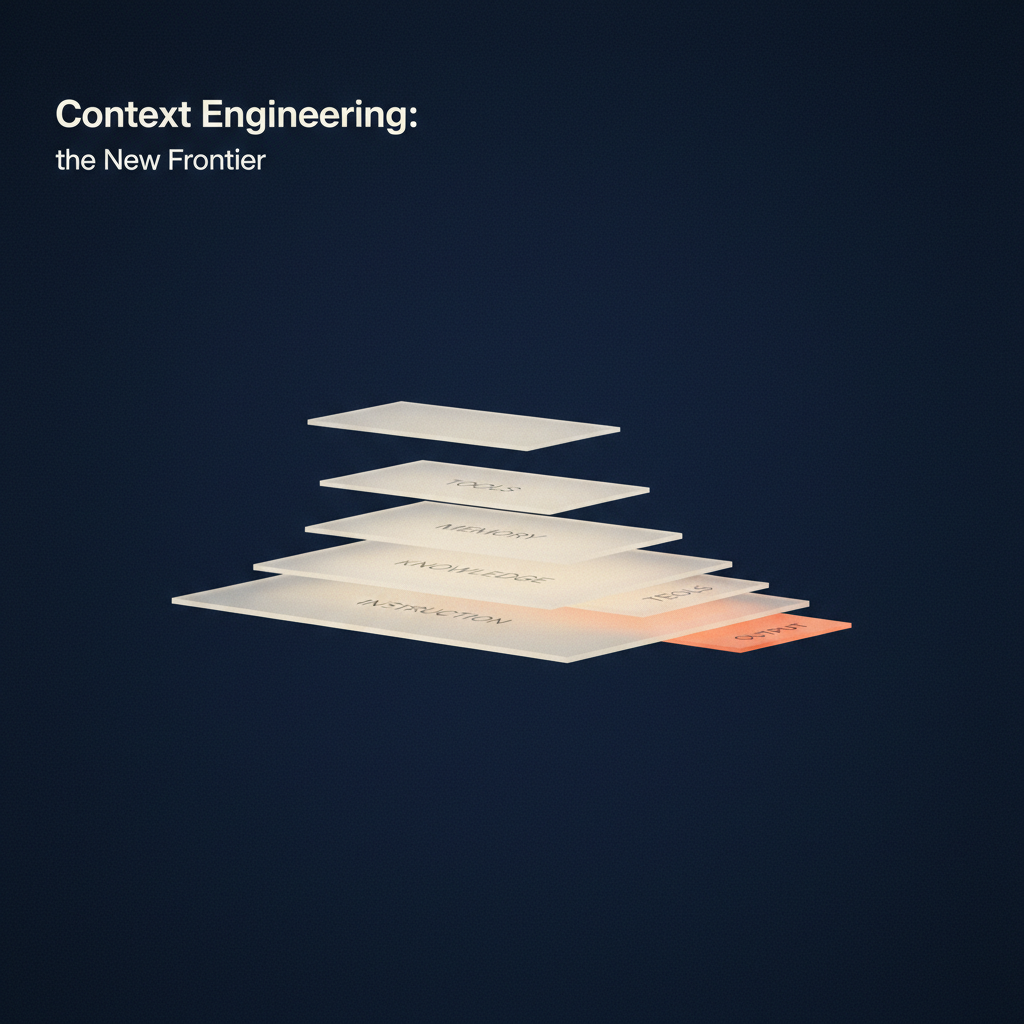
A mature applied AI operation treats context engineering as five distinct layers, each with its own decisions.
Layer 1 — Instruction context (system prompt and agent identity)
The layer closest to traditional prompt engineering, but with a broader scope. It includes:
- Agent role and identity (who it is, who it responds to, what its authority is)
- Policy and restrictions (what it can and cannot do, tone, language)
- Expected output format (markdown, JSON, prose, with specific sections)
- Quality criteria (what counts as a good response)
In well-executed context engineering, this layer is not generic. It is calibrated per use case. An editorial review agent has a different identity from a lead qualification agent, even if the base model is the same.
Layer 2 — Knowledge context (RAG and retrieved data)
The layer that has grown most in importance. Instead of relying on what the model "knows" from training, RAG (Retrieval-Augmented Generation) injects, with each call, the most relevant snippets of domain-specific knowledge.
Critical decisions for this layer:
- Source of truth: what goes into the index? Company documents, customer base, old posts, call transcripts?
- Chunking strategy: how to break down documents? By paragraph, section, semantically?
- Embeddings model: which model generates the vectors? What is the dimensionality?
- Retrieval strategy: simple cosine similarity? Hybrid (BM25 + vector)? Re-ranking?
- How many chunks to inject: 3, 5, 10, 20? Trade-off between coverage and noise.
- How to present to the model: together or separated by source? With or without metadata?
Each of these decisions directly impacts response quality — and none are resolved by "optimizing the prompt."
Layer 3 — Memory context (short and long term)
Memory is the layer that distinguishes a useful assistant from a chatbot. It has two dimensions:
- Short-term memory (conversation memory): history of the current conversation. In long conversations, it becomes a bottleneck — it doesn't fit entirely in the window.
- Long-term memory (persistent memory): facts about the user, past decisions, preferences. Persists across sessions.
Memory engineering answers questions like: what is worth remembering versus discarding? How to summarize long conversations without losing the essential? How to retrieve relevant memory without cluttering the context with irrelevant information?
In 2026, tools like Anthropic Memory API, OpenAI Threads, and custom implementations (LangGraph, LlamaIndex) standardized this layer — but the engineering of what to memorize remains a design decision, not automatic.
Layer 4 — Tool context (function calling and MCP)
When an agent has access to tools — calling an API, reading a file, executing a query — the definition of these tools enters the context. And this is more delicate than it seems.
Critical decisions:
- Which tools to expose to which agent: exposing all degrades performance; exposing too few limits capability
- How to name and describe each tool: the model decides when to call based on this description
- Parameter schema: optional parameters, defaults, validations
- How to present tool results: raw, summarized, formatted
Model Context Protocol (MCP) standardized this layer as an open protocol — an agent in Claude, ChatGPT, or another model consumes the same tools via MCP servers. But the engineering of which tools and how to describe them remains human work per agent.
Layer 5 — Output context (format, structure, and validation)
The least discussed and often underestimated layer. It defines how the response should be structured so that the downstream system can consume it.
- Structured JSON when another system will parse it
- Markdown with specific sections when a human will read it
- Separated chain-of-thought when you want to see the reasoning but not display it
- Tool calls in a specific format when the agent will execute actions
In mature context engineering, this layer uses explicit schemas (JSON Schema, Pydantic, Zod), automated validation, retry with feedback — not just "I hope the model returns the right format."
Comparison: Prompt Engineering vs. Context Engineering
To make the difference concrete:
| Dimension | Prompt Engineering (2023) | Context Engineering (2026) |
|---|---|---|
| Focus | User instruction text | Complete system of inputs to the model |
| Optimization | Rewriting phrases, adding examples, magic words | Deciding what to retrieve, remember, expose, format |
| Dominant Discipline | Linguistics | Software engineering |
| Typical Stack | Pure LLM + long prompt | LLM + RAG + memory + tools + validation |
| Key Metric | Isolated response quality | Response quality in production, at scale |
| Who Does It | Prompt engineer / writer | AI engineer / context engineer |
| Effort Where | Rephrasing prompt | Designing context pipeline |
| Typical Error | Poorly written prompt | Cluttered or incomplete context |
The honest assessment: prompt engineering became a subset of context engineering. It remains important — Layer 1 (instruction) is literally that — but it's 1 of 5 layers.
Why LLMs Pay Attention to Well-Designed Context
Even with 1M token windows, models don't treat all context equally. Studies on "lost in the middle" (Liu et al., 2024) showed that LLMs pay more attention to information at the beginning and end of the context, and less in the middle. In long windows, this becomes a serious problem.
Well-executed context engineering takes this into account:
- Critical information at the beginning or end, not buried in the middle
- Clear structure (headings, separators, markup) for the model to know where each thing begins
- Directed retrieval (don't throw 50 chunks; choose the 5 most relevant)
- Breaking down long tasks into sub-tasks with leaner context
The consequence: two systems with the same base model and the same prompt can have radically different quality depending on how the context was engineered.
How Draivv Rank Applies Context Engineering in Production
Draivv Rank — Draivv's platform for automated SEO + GEO, operated in Brazil by Draivv — is a concrete example of context engineering in production. Each piece of the architecture is a context decision:
- Layer 1 (Instruction): each agent in the editorial flow — research, outline, generation, review, technical SEO, maintenance — has its own identity and policy. Nothing is generic.
- Layer 2 (Knowledge): RAG over the client's brand kit, fact base, previous articles. Before generating a section, the system retrieves the most relevant snippets from the specific client's knowledge base.
- Layer 3 (Memory): editorial feedback history, tone calibration decisions, cluster patterns — persist across executions.
- Layer 4 (Tools): integration via MCP with DataForSEO, GSC, GA4, embeddings database, WordPress, Shopify. Each agent sees only the tools it needs.
- Layer 5 (Output): specific editorial structure (TL;DR + tables + FAQ schema-ready + citations), validated before publication.
For the technical details of the architecture, see the pillar How we built Draivv Rank: the AI stack behind automated SEO + GEO. It opens the hood of each layer above as a practical example.
Get the next articles by email
New content from Draivv, straight to your inbox. No spam.
Minimum Stack for Effective Context Engineering
The good news is that, in 2026, the tooling became accessible. Minimum stack for any company to start:
| Need | Consolidated Options |
|---|---|
| LLM with long window | Claude Sonnet 4.6 (1M), Gemini 2.5 Pro (1M), GPT-5 (200k+) |
| Embeddings | OpenAI text-embedding-3-large, Cohere Embed v3, Voyage AI |
| Vector DB | Pinecone, Weaviate, pgvector (Postgres), Chroma |
| Orchestration framework | LangGraph, LlamaIndex, Pydantic AI, custom frameworks |
| Tool protocol | MCP (open standard), native function calling |
| Persistent memory | Anthropic Memory API, mem0, custom in DB |
| Evaluation (evals) | Braintrust, Langfuse, Helicone, LangSmith |
Important: stack does not replace engineering. Pinecone doesn't decide what to index; LangGraph doesn't decide which agents to design; MCP doesn't decide which tools to expose. Tools operate the decisions — they don't make them.
Common Mistakes in Context Engineering
Five patterns that appear in almost every beginner operation.
1. Context overflow. Believing that "more context = better response" and injecting everything possible. Long windows don't mean the model pays equal attention to everything. Cluttered context worsens the response. The rule: less is more, when less is relevant.
2. RAG without re-ranking. Retrieving the top-10 chunks by simple similarity and injecting all of them. The 5 most relevant by re-ranking are almost always better than the 10 most "similar." The difference between amateur RAG and professional RAG is here.
3. Memory that doesn't forget. Accumulating all conversations indefinitely without summarization or discarding. In a few iterations, memory becomes the quality bottleneck — because everything that was there enters the new context.
4. Too many tools per agent. Exposing 30 functions to a single agent. Performance drops, latency increases, errors rise. The rule: specialized agents with specialized tools, not generalists.
5. Unvalidated output. Expecting the model to return the correct format "because I asked in the prompt." In production, this breaks. Automatic validation with structured retry (Pydantic AI, native structured outputs) is part of the output layer.
Context Engineering and the Next Generation of AI Professionals
The "prompt engineer" profession was ephemeral. The profession that replaced it — AI engineer / context engineer — requires a different profile:
- Technical foundation in software engineering (not just linguistics or design)
- Familiarity with APIs, schemas, validation, infrastructure
- Ability to think in systems, not isolated phrases
- Attention to continuous evaluation (evals, production metrics)
- Product vision (understanding what the end-user needs to define the right context)
Job postings that asked for "experience with prompt engineering" in 2023 now ask for "building applications with LLMs in production, RAG, agents, MCP." The semantics changed because the work changed.
For those learning applied AI now, the most useful path is not to study prompt techniques. It is to study how AI systems are built — and prompt enters as a piece in this larger puzzle. Consolidated resources in 2026: official Anthropic documentation (Engineering with Claude), Andrew Ng's AI Engineering course, blogs like Hamel Husain, Eugene Yan, Simon Willison.
Frequently Asked Questions about Context Engineering
Does Context Engineering completely replace Prompt Engineering?
No. It replaces it as a central profession, but prompt engineering remains a sub-discipline within context engineering — specifically Layer 1 (Instruction context). What changed is that prompt ceased to be the main job and became a detail within something larger.
Can I apply Context Engineering without a technical team?
In part. No-code/low-code platforms (Make, Zapier AI, Bubble with AI) implement context engineering patterns under the hood. But for serious production cases — RAG over proprietary data, agents with specific tools, scaled systems — it's engineering work. The good news: the tooling has become accessible for small teams with a technical profile.
How much does it cost to set up a Context Engineering operation?
Depends on the scale. For a prototype: the stack can run below US$ 100/month (LLM API + vector DB free tier + open-source framework). For production with real volume: typically US$ 500–5,000/month considering LLM calls, embeddings, managed vector DB, and observability. The dominant cost is almost always the LLM, not infrastructure.
What is the relationship between Context Engineering and MCP?
MCP (Model Context Protocol) is the open standard that standardizes Layer 4 (Tool context). Instead of each agent reimplementing how to connect to each tool, MCP provides a single protocol. It is part of context engineering — specifically the tools part. It does not replace the other layers.
Will Context Engineering become a commodity like prompt engineering?
Yes and no. The basic patterns will become commoditized — any decent platform already implements RAG, persistent memory, function calling. What continues to differentiate is the domain-specific engineering: what knowledge to index, how to represent user memory, which tools to expose, how to validate output in the product context. This part remains high-value human work.
How to measure if Context Engineering is good?
Metrics that matter: (1) rate of factually correct responses in test cases; (2) average latency; (3) cost per call; (4) detected hallucination rate; (5) end-user satisfaction. Tools like Braintrust, Langfuse, and LangSmith automate the collection and analysis of these metrics — without continuous evals, context engineering becomes a matter of faith.
Which companies are doing Context Engineering well in 2026?
In public references: Anthropic (Claude and Claude Code), Perplexity (generative search), Cursor (coding agent), Notion (integrated AI features), Linear (agents for product management), GitHub Copilot. In Brazil, public cases are still consolidating — but national B2B SaaS (including Draivv Rank) already operate with context engineering as a central discipline.
Is it worth learning prompt engineering before context engineering?
Yes, but with the right proportion. Spend 10–20% of the time on prompt engineering (writing good instructions is still necessary) and 80–90% on context engineering (designing the system around it). The inverse order — becoming a prompt specialist before learning the rest — is obsolete.
Conclusion: The Job Changed, The Name Changed, The Game Continues
Context Engineering is not a rebrand hype. It's an honest recognition that AI in production has moved beyond "chatting with a chatbot" and become complex systems with multiple layers of context. Those who continue to treat it as prompt engineering are optimizing 20% of the problem and ignoring 80%.
The good news: the discipline is learnable. Frameworks exist, tooling has become accessible, official documentation from major providers (Anthropic, OpenAI, Google) explains patterns in detail. What most companies lack is doing, not knowing.
For those leading AI within a company in 2026, the operational question is: which of the five layers of context engineering is weakest in your current operation — and which will you tackle first?
Draivv develops and operates Draivv Rank, an automated SEO and GEO platform for B2B. In Brazil, the engine is operated by Draivv as a managed service. Context engineering is the technical foundation that supports all layers of the product — from editorial research to technical publication. Learn more about Draivv or continue reading our technical series on applied AI.
Related Content
This pillar connects with Draivv's entire technical series:
- How we built Draivv Rank: the AI stack behind automated SEO + GEO — context engineering applied in production
- Prompt engineering for businesses: what changes in production — Layer 1 in depth
- RAG vs Fine-tuning: when to use each in your company — Layer 2 in depth
- AI Agents: what they are, how they work, and how to apply them — where context engineering becomes a multi-agent system
- MCP (Model Context Protocol): why Anthropic changed the AI integration game — standardized Layer 4
- Claude vs ChatGPT in 2026: which model to choose for your company — the base LLM that supports the context
- Claude Sonnet, Opus, and Haiku: which model for which task — model selection by stage
- Build vs Buy in AI: when to buy ready-made SaaS and when to build your own — strategic decision preceding engineering
- SEO + GEO in 2026: why AI changed the search game — where AI meets the buyer
Next Step with Draivv
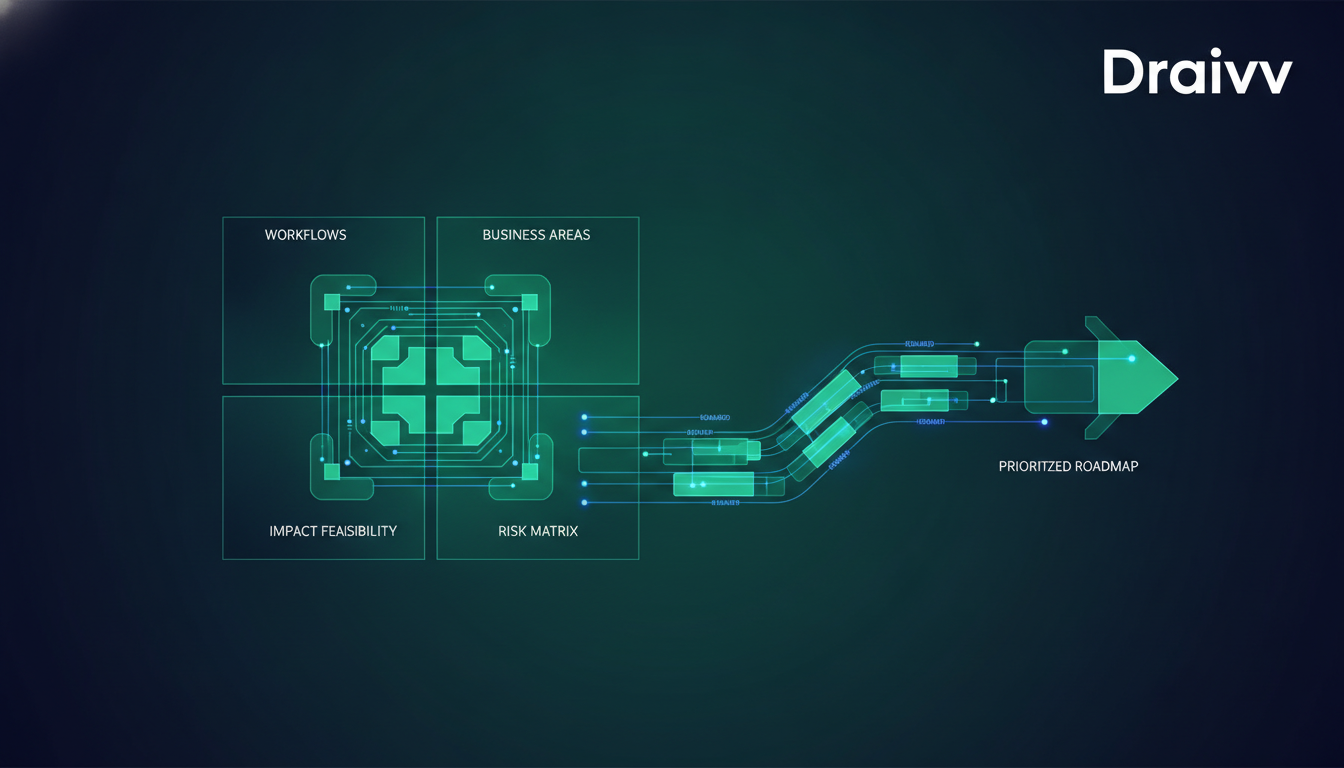
Applying AI with results begins with choosing the right problem, data feasibility, and a clear business metric. Discover the AI for Business Diagnostic to transform scattered opportunities into a prioritized application roadmap.