
Multi-Agent Systems are AI architectures where multiple specialized agents collaborate to solve a problem — instead of a single generalist agent. By 2026, they have become the dominant architectural pattern for complex cases: deep research, editorial generation, commercial workflow automation, and coding agents. But multi-agent isn't always better: it comes with latency, cost, and complexity overhead that only pays off when the problem truly demands specialization. This pillar explains orchestration patterns, when to use them, when to avoid them, and the consolidated stack.
The defining question for applied AI in 2026 is simple: one agent or several?
In 2024, single agents with enormous context windows and varied tools seemed sufficient for almost everything. ChatGPT with plugins, Claude with computer use, Gemini with its integrated ecosystem. The promise was: give the model the context and tools, and it will solve the problem.
By 2026, the reality became clearer. For complex tasks — deep research, editorial generation, software debugging, legal analysis, multi-layered customer service — single agents hit a ceiling. Context becomes polluted, decisions compete, and specialization doesn't emerge. The architectural answer that dominated: multi-agent systems.
But multi-agent also became a trap. Teams excited by the idea build systems with 8, 10, 15 agents for problems that a well-engineered single agent could solve alone — and spend 5x more on latency, cost, and bugs.
This pillar explains when it makes sense to use multi-agent systems, what the consolidated orchestration patterns are, which stack to choose, and the mistakes that destroy the ROI of these systems.
What is a Multi-Agent System
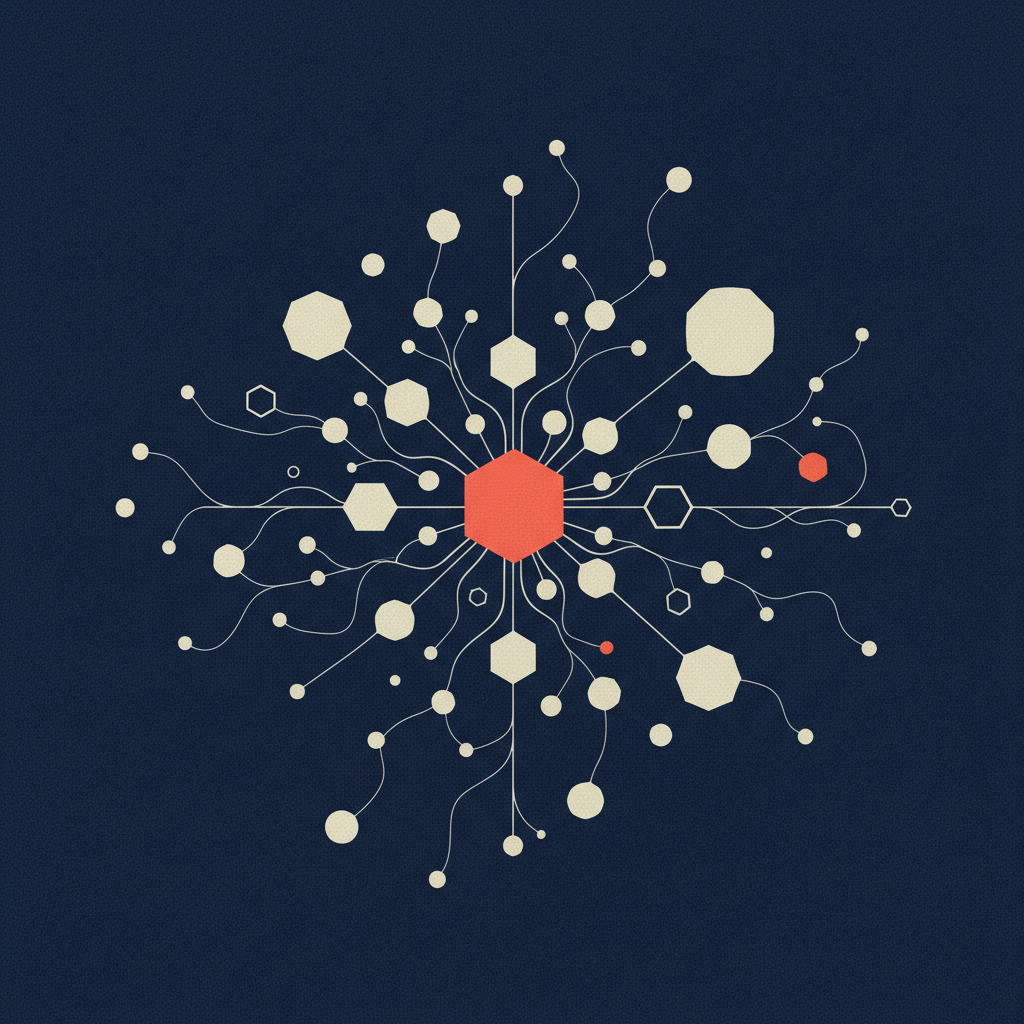
A multi-agent system is an architecture where multiple AI agents, each with its own role, context, and tools, collaborate to execute a task. Each agent is an LLM with a specific prompt and (usually) a restricted scope.
Typical examples in production in 2026:
- Deep research: one agent searches, another reads, another synthesizes, another writes
- Editorial generation: one agent outlines, another writes, another revises, another publishes
- Coding agents: one agent plans, another implements, another tests, another reviews
- Customer service: one agent classifies, another handles routine responses, another escalates to a human
- Legal analysis: one agent extracts clauses, another identifies risks, another drafts a memo
The defining characteristic is specialization with structured communication. It's not enough to have two LLMs running — multi-agent requires a clear protocol for who calls whom, how context is passed, and how to decide when to terminate.
Why Multi-Agent Won the "Giant Single Agent" Bet
Three forces converged to the dominance of multi-agent architectures in 2026.
1. Polluted context degrades quality. Even with 1M token windows, single agents with many tools and too much knowledge in the system prompt end up confusing priorities. Studies on "lost in the middle" and "context degradation" showed that LLMs pay less attention to information buried in the middle of long contexts. Specialized agents, with lean and specific context, perform better in their specific functions.
2. Isolated failures instead of cascades. When a single agent fails, the entire task fails. When an agent in a multi-agent system fails, the orchestrator can retry, escalate to a human, or use an alternative path. Robustness increases.
3. Parallelism. Independent sub-tasks run in parallel. A single agent is sequential by nature — multi-agent allows for real work splitting. In deep research, this reduces latency from minutes to seconds.
The practical consequence: the question is no longer "how do I make one agent do everything?" but rather "how do I decompose this problem into specialized agents that collaborate effectively?"
The Five Consolidated Orchestration Patterns
Multi-agent in production follows recognizable patterns. Five that dominate in 2026:
1. Supervisor-Worker (most common)
A "supervisor" agent receives the task, decomposes it into sub-tasks, and dispatches them to specialized "worker" agents. Workers return results to the supervisor, who consolidates and responds.
When to use: Clearly decomposable tasks (research, writing, analysis). When the supervisor can plan before execution.
Trade-offs: The supervisor becomes a single point of failure. If it decomposes poorly, everything stalls. But it's the simplest pattern to implement and debug.
2. Sequential Pipeline
Agents process the output of the previous one in a linear flow. Output of Agent A → Agent B → Agent C → final response. No dynamic routing decision.
When to use: Workflows with well-defined steps and fixed order (editorial generation: outline → text → review → publication).
Trade-offs: Lacks flexibility. If the task requires feedback (reviewer needs to request a revision from the generator), a pure pipeline is not enough — it becomes a workflow with feedback loops.
3. Mesh (peer-to-peer)
Agents communicate directly with each other without a central hierarchy. Each agent can call any other.
When to use: Complex simulations, agent debates (each defending a different position), brainstorming.
Trade-offs: Difficult to predict behavior. Difficult to debug. Almost never the best choice — usually used when other patterns don't fit.
4. Hierarchical (multi-level)
Supervisor of supervisors. A top-level agent decomposes into domains; agents within each domain decompose into sub-tasks; workers execute. Tree structure.
When to use: Large and well-structured problems (organizational consulting, complex project planning, modular code).
Trade-offs: Latency increases with depth. Cost likewise. Good when the problem genuinely has a natural hierarchy; bad when forcing an artificial hierarchy.
5. Debate / Multi-perspective
Multiple agents generate independent responses, then a "judge" agent compares and chooses — or an "aggregator" agent synthesizes positions.
When to use: High-stakes decisions where diversity of perspective reduces error (legal analysis, medical diagnosis, strategic decision-making).
Trade-offs: Expensive (multiple parallel calls). Slow in aggregation. Justified only when the cost of error from a single agent is high.
When NOT to Use Multi-Agent
The most important question for multi-agent in 2026 is "when to avoid it?". Five signs that multi-agent is overkill:
1. The task is well-solved by a single agent. If a single agent with a good prompt + RAG + 3-5 tools solves it with acceptable quality, multi-agent only adds complexity.
2. Latency is critical. Multi-agent multiplies LLM calls. For real-time UX (chat, conversational assistant), the overhead can be unacceptable.
3. Limited token budget. Each agent consumes tokens. Multi-agent systems cost 3-10x more per task than a single agent. For products with tight pricing, multi-agent makes margins unfeasible.
4. Team doesn't yet operate evals. Multi-agent systems are much harder to debug and calibrate. Without robust evals already in place, quality will fluctuate invisibly.
5. Problem is ill-defined. Decomposition into sub-tasks only works if the main task is clear. For exploratory problems, a single agent allows for faster iteration. Multi-agent comes later, when workflows become stable.
The heuristic that works: start with a single agent, monitor where it fails, decompose only where the failure is structural. Multi-agent emerges from necessity, not from initial choice.
How Draivv Rank Operates as a Multi-Agent System
Draivv Rank — Draivv's platform for automated SEO + GEO, operated by Draivv in Brazil — is a practical example of a multi-agent system in editorial production. The architecture uses a sequential pipeline with controlled feedback pattern:
- Research agent: queries DataForSEO + GSC + GA4, builds a structured brief
- Outline agent: defines h2/h3, FAQ, angle, internal linking based on the brief
- Generation agent: writes section by section, with RAG on the client's brand kit
- Auditor agent (LLM-as-judge): scores E-E-A-T, factual accuracy, depth, tone — returns score and justification
- Technical SEO agent: applies schema, OG, canonical, sitemap after editorial approval
- Maintenance agent: monitors performance, detects cannibalization, suggests refresh
Each agent has a specific prompt, restricted tools (via MCP), and an appropriate model (Opus for judgment, Sonnet for volume, Haiku for mechanical tasks). The orchestrator manages the flow with mandatory human review checkpoints before publication.
The architectural decision to use multi-agent came from observation: a single agent trying to do "research + writing + review + publication" produced mediocre content in three dimensions. Specialized agents, each with its own criteria, elevated the output quality while maintaining consistency.
For a complete architectural breakdown, see How We Built Draivv Rank: The AI Stack Behind Automated SEO + GEO.
Consolidated Stack for Multi-Agent in 2026
Consolidated frameworks, with known pros and cons:
Get the next articles by email
New content from Draivv, straight to your inbox. No spam.
| Framework | Origin | Strength | Limitation |
|---|---|---|---|
| LangGraph | LangChain | Explicit control, supports complex patterns, observability via LangSmith | Higher learning curve |
| CrewAI | Open-source | High abstractions, fast to prototype | Less flexible in complex cases |
| AutoGen | Microsoft | Good for conversational and debate patterns | Fragmented documentation |
| Mastra | TypeScript-first | Modern stack, integrates well with Next.js | Newer, smaller community |
| Anthropic Agent SDK | Anthropic | Official patterns for Claude, native MCP | Claude ecosystem specific |
| OpenAI Swarm/Agents SDK | OpenAI | Simple for OpenAI-only cases | Vendor lock-in |
The choice between them depends less on technical quality and more on existing stack + problem profile. LangGraph won in enterprise adoption due to its maturity. Mastra grew rapidly in modern TypeScript teams. CrewAI remains relevant for rapid prototyping.
Common Mistakes in Multi-Agent Architectures
Five patterns that destroy the ROI of multi-agent systems:
1. Too many agents. Excessive decomposition. A system with 10 agents where 3 would suffice. Latency increases, cost explodes, debugging becomes a nightmare.
2. Implicit communication. Agents assuming what other agents "should know." Without an explicit context passing protocol, decisions fall through the cracks between agents, and quality plummets.
3. Same LLM instance for all. Using Claude Sonnet (or GPT-5) for all agents, including mechanical ones. Expensive waste. Mechanical agents can run on Haiku or smaller models; only the supervisor and judges need maximum capacity.
4. No evals per agent. Measuring only the final output. When quality drops, no one knows which agent is to blame. Evals per agent are mandatory practice.
5. Uncontrolled infinite loops. Agent A calls B, B calls A, creating a loop. Without a maximum iteration limit and timeout, the cost silently explodes. Implement circuit breakers from day 1.
Multi-Agent and the Next Frontier: Autonomous vs. Supervised Agents
The technical discussion defining 2026-2027 isn't "to use multi-agent or not." It's "how much autonomy to give agents?"
Two extremes:
- Supervised: Human approves critical decisions (publication, spending, irreversible action). Multi-agent aids production; human validates.
- Autonomous: Agents execute end-to-end without human intervention. More scale, more risk.
In 2026, the practical consensus in B2B is: gradual autonomy, with human checkpoints where the cost of error is high. In serious commercial production, no one in their right mind gives full autonomy to agents for irreversible actions (publishing content on a client's domain, making financial transactions, sending external communications).
The operational question: at what point in your multi-agent workflow does a human need to be involved? A good answer resolves 80% of risk discussions in applied AI.
Frequently Asked Questions about Multi-Agent Systems
What is a multi-agent system in one sentence?
A multi-agent system is an AI architecture where multiple specialized agents, each with its own role and tools, collaborate via a structured protocol to solve tasks that a single agent would solve poorly or not at all.
When is it not worth using multi-agent?
When a single agent solves the problem with acceptable quality; when latency is critical; when the token budget is tight; when the team doesn't yet have robust evals; when the problem is still being explored and there is no stable workflow.
What's the difference between multi-agent and an agent with many tools?
An agent with many tools is a single LLM deciding what to call — internal competition for priority. Multi-agent involves several LLMs, each specialized in a sub-domain. The practical difference: multi-agent scales better in quality as the problem grows; an agent with many tools degrades when the number exceeds 10-15.
Which framework to use for multi-agent in 2026?
For Python + enterprise cases: LangGraph (mature, observability via LangSmith). For rapid prototyping: CrewAI. For TypeScript-first: Mastra. For Claude-only cases with MCP: Anthropic Agent SDK. For the OpenAI ecosystem: Swarm/Agents SDK. The choice depends more on the existing stack than on technical capability.
How much does multi-agent cost in production?
Typically 3-10x more per task than a single agent, in tokens. A well-designed multi-agent system uses smaller models for mechanical agents (Haiku, GPT-5 mini) and top models only where critical judgment is needed (supervisor, auditor). This optimization reduces cost by 50-70% without losing quality.
Can multi-agent run without human-in-the-loop?
Technically, yes. In responsible production, no. For reversible actions (drafting, suggestion, analysis), full autonomy makes sense. For irreversible actions (publication, transaction, external communication), a human checkpoint is good practice until evals prove the risk is manageable.
How to debug when multi-agent fails?
Three combined practices: (1) complete observability (LangSmith, Langfuse, Braintrust) with a trace of each call from each agent, (2) evals per agent in addition to the final output, (3) deterministic replay — the ability to reproduce an exact execution with the same input to investigate. Without these three, debugging becomes trial and error.
Is multi-agent just hype or is it here to stay?
It's here to stay — not as a silver bullet, but as an architectural pattern for complex cases. Every serious AI company in production (Anthropic, OpenAI, Cursor, Perplexity, Notion) uses multi-agent in some workflow. The hype is in "use multi-agent for everything"; the truth is "use multi-agent when the problem truly demands it."
Can I evolve from a single agent to a multi-agent system gradually?
Yes, and it's the recommended path. Start with a single agent, measure where it fails, identify natural decomposition, then extract the agent that fails most as a specialized worker. Organic growth. Trying to design a perfect multi-agent system from day 1 almost always results in over-engineering.
Conclusion: Multi-agent is not the answer — it's an answer among others
AI maturity in 2026 isn't about "using multi-agent." It's about knowing when to use it, when to avoid it, and how to measure if it's worthwhile. Teams that master this decision scale AI economically and sustainably. Teams that treat multi-agent as a mandatory trend spend more without delivering proportionally.
The operational question for anyone building AI today: looking at the AI workflows you already have in production, which one is a natural candidate for decomposition into specialized agents — and which one is well-served by the current single agent?
A clear answer separates serious AI engineering from demo AI.
Draivv develops and operates Draivv Rank, an automated SEO and GEO platform for B2B. The product's multi-agent architecture — research, outline, generation, auditing, technical SEO, maintenance — is a practical example of the patterns discussed in this pillar. In Brazil, the engine is operated by Draivv as a managed service. Learn more about Draivv.
Related Content
- AI Agents: What they are, how they work, and how to apply them — fundamentals of the individual agent
- Context Engineering: The discipline replacing prompt engineering in 2026 — what sustains each agent in the system
- AI Evals: How to evaluate AI performance in production — without evals, multi-agent becomes a gamble
- How We Built Draivv Rank — multi-agent applied in editorial production
- MCP (Model Context Protocol) — how agents share tools
- RAG vs Fine-tuning — agents' knowledge base
- Claude Sonnet, Opus, and Haiku: Which model for which task — model calibration per agent
- Build vs Buy in AI — strategic decision preceding architecture
Next Step with Draivv
Applying AI with results begins with choosing the right problem, data viability, and a clear business metric. Explore our AI for Business Diagnostic to transform scattered opportunities into a prioritized application roadmap.